- Four things that change the answer
- The water beside the GPU is only the beginning
- Four stages between a hot chip and the outdoors
- Cold plate
- Recirculating coolant
- CDU or equivalent system
- Heat rejection
- A cooling tower loses water on purpose
- Does this mean dry cooling is always better?
- Three ways to remove heat
- A 100 MW study found that cooling design can change annual water demand
- Same 100 MW study, different water demand
- Why Dallas and Paris are different
- Warmer coolant can help save water
- A closed loop is not the same as a waterless data center
- Water and electricity need separate metrics
- What a local community should ask
- Six questions that reveal the real water demand
- The most important cooling decision may happen outside the server room
- Sources and Methodology
A liquid-cooled AI rack can have coolant running through its processors, manifolds and flexible hoses for years. Now imagine someone living near the data center asks a simple question: how much of our water will it use?
Looking at the server cannot answer it. The liquid passing through a GPU cold plate might circulate in a sealed system without being routinely discarded. Meanwhile, another part of the same building could be using water to release heat into the atmosphere.
That distinction matters as AI data centers become larger and more power-dense. In September 2026, Schneider Electric published a comparative study of 100 MW data center cooling designs. Its modeled results showed substantial differences in annual on-site cooling water use depending on the cooling architecture and local climate.
The question is not simply whether a data center uses liquid cooling. It is what happens to the heat after the liquid leaves the server.
Four things that change the answer
- Liquid cooling at the chip does not automatically mean high water consumption at the facility.
- A closed coolant loop can reuse its liquid while a separate cooling system consumes water.
- Cooling towers use evaporation to reject heat. Dry coolers mainly transfer heat to outdoor air.
- Climate, coolant temperature, cooling equipment and operating strategy all affect the outcome.
The water beside the GPU is only the beginning
Modern high-density computing hardware generates significant heat. A cold plate mounted against a processor transfers that heat into flowing coolant. Pumps move the warm liquid away from the hardware, while supply lines bring cooled liquid back.
The coolant can be water-based, often with appropriate additives, depending on the system specification. Its job is to transport heat, not to evaporate inside the server.
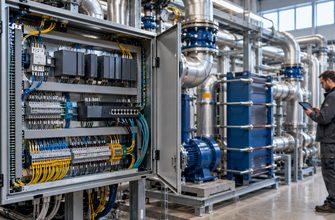
Many installations use a coolant distribution unit, or CDU. A heat exchanger inside the CDU transfers heat between the server-side coolant circuit and a facility-side cooling circuit. The two fluids can exchange heat without physically mixing.
That separation is important for managing coolant chemistry, pressure, cleanliness and maintenance. It also helps explain why the amount of water circulating through servers cannot be treated as the amount of water consumed by the data center.
Four stages between a hot chip and the outdoors
-
01 / THE CHIP
Cold plate
Heat from the processor enters a metal cold plate and warms the flowing coolant.
-
02 / THE RACK LOOP
Recirculating coolant
Warm coolant travels out of the rack through a closed or controlled circuit.
-
03 / THE EXCHANGER
CDU or equivalent system
Heat passes to another cooling circuit. The two liquids need not mix.
-
04 / OUTSIDE
Heat rejection
Dry coolers, chillers, cooling towers or other systems transfer heat away from the facility.
Conceptual flow, not a piping diagram. Actual data centers may have additional heat exchangers, pumps, backup systems and separate cooling paths for equipment still cooled by air.
The chip might always be cooled by the same recirculating liquid. Yet the final stage could use very different amounts of fresh water.
Our earlier examination of heat removal inside a 135 kW AI rack follows the first part of this journey. The larger water question starts when that heat reaches the facility cooling plant.
A cooling tower loses water on purpose
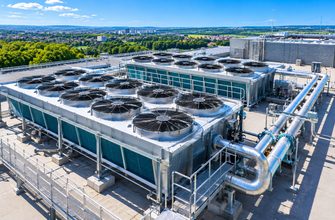
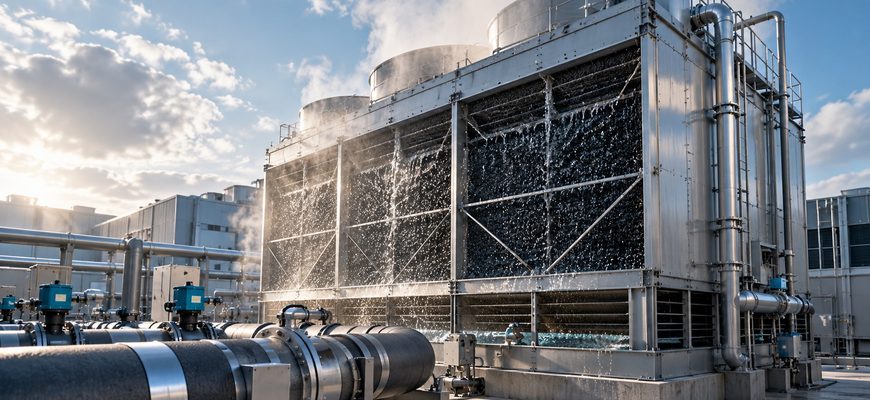
Consider an evaporative cooling tower. Warm water moves through the tower, and air passes over it. Some of that water evaporates, carrying thermal energy away.
This is not necessarily a leak or a failed system. Evaporation is the mechanism that helps the tower reject heat.
But evaporated water must be replaced. Cooling towers also commonly discharge some circulating water, called blowdown, to control the concentration of dissolved minerals.
The water supplied to replace evaporation and blowdown is known as makeup water. The discharged blowdown is not the same as the water that evaporates, and a proper water-balance report should distinguish them.
Three different quantities: Water withdrawal is water taken from a source. Water consumption refers to water no longer available for immediate reuse in that source or local water system. Discharge is water returned to a wastewater or other receiving system, potentially requiring treatment.
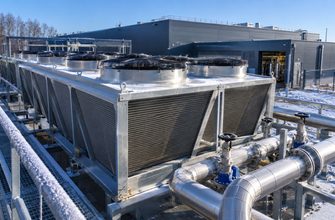
In contrast, a dry cooler uses fans and heat-exchanger surfaces to move heat into the surrounding air without relying on evaporating water during dry operation.
A data center may also use hybrid or adiabatic-assisted equipment. Such systems can operate dry under some conditions and use water assistance when temperatures rise or additional cooling capacity is needed.
Does this mean dry cooling is always better?
Not automatically. Dry cooling systems must move large volumes of air and may need more heat-exchanger area, fan power or mechanical refrigeration, depending on design and weather.
Evaporative systems can reduce electrical cooling demand under suitable conditions, but they do so by consuming water.
The correct comparison has two sides: water required on-site and electricity required to reject the same heat.
Three ways to remove heat
| System | Heat rejection | Water implication |
|---|---|---|
| Evaporative tower | Evaporates a portion of circulating water to remove heat. | Requires makeup water; also commonly produces blowdown. |
| Dry cooler | Uses heat exchangers and outdoor airflow without evaporation. | No routine process-water evaporation during dry operation. |
| Hybrid or adiabatic | Combines dry heat rejection with water assistance under selected conditions. | Water demand depends on weather, operating settings and runtime. |
General engineering comparison. A facility may combine multiple approaches, including mechanical chillers, water reuse and heat-recovery equipment.
A 100 MW study found that cooling design can change annual water demand
On September 21, 2026, Schneider Electric released a comparative analysis of 100 MW AI data center designs.
Its announcement compared a modeled air-cooled AI data center with an optimized liquid-cooled design using adiabatic heat rejection. It reported reductions in annual on-site cooling water use in both Dallas and Paris.
Same 100 MW study, different water demand
From approximately 382,000 to 197,000 cubic meters per year.
From approximately 108,000 to 51,000 cubic meters per year.
Source: Schneider Electric, September 21, 2026. Values describe modeled annual on-site cooling water use for specified 100 MW designs. They are not observed consumption figures, universal liquid-cooling savings, or measurements performed by il.digital.
These figures should not be read as a promise that every liquid-cooled data center will cut its water consumption by half.
Schneider modeled particular designs with particular assumptions. The outcome depended on cooling technology, temperatures and climate. A different facility could produce a different comparison.
Still, the result challenges a common assumption: the presence of liquid inside an AI rack does not, by itself, determine how much fresh water the building consumes.
Why Dallas and Paris are different
Outdoor conditions change the cooling equipment’s job.
When outside air is sufficiently cool, a dry cooler can release heat without evaporative assistance. During hotter conditions, the temperature difference is smaller, and the system may require more airflow, additional equipment or water-assisted cooling.
Humidity also matters for evaporative performance. A design that works well in one climate cannot be assessed independently of another location’s temperature and humidity profile.
This is why annual modeling is more useful than a single summer-day snapshot, provided the assumptions are disclosed.
Warmer coolant can help save water
It sounds backward. AI processors run hot, so why would an engineer choose warmer cooling water?
Because the temperature required by the processor and the temperature useful for rejecting heat outdoors are not the same engineering question.
If the hardware can be cooled safely with warmer supplied coolant, the facility may have a larger temperature difference between its returning liquid and outside air across more operating hours.
That can let dry cooling equipment do more of the work before a water-consuming cooling stage is needed.
Schneider Electric’s October 16 analysis discussed designs using a technology cooling system supply temperature of 45 degrees Celsius instead of 32 degrees Celsius. In its modeled configurations, the warmer-water approach enabled more free cooling, with differing trade-offs in equipment capacity and capital cost.
Technical Note: This is not advice to raise the coolant temperature of an existing AI rack. Permitted inlet temperatures depend on the hardware, cold plates, flow rates, coolant specification and manufacturer’s operating envelope. The facility must meet all component temperature limits.
A facility designed for warm-water cooling may reject its heat with less evaporative assistance. But the most water-efficient configuration may require more equipment or a different investment strategy.
Water consumption, electricity demand and capital cost have to be considered together.
A closed loop is not the same as a waterless data center
Some operators now describe cooling designs with zero water evaporation for normal chip-cooling operations.
Microsoft, for example, describes a direct-to-chip system in which coolant circulates in a closed loop while air-based cooling equipment rejects heat outside.
That can remove the routine requirement to evaporate water for chip cooling. But it does not establish that an entire data center uses no water.
Water may still be required for initial filling, maintenance, cleaning or other building operations. Other cooling systems at the same site may work differently.
A closed loop can also lose coolant through leakage or servicing, although it is designed to retain and reuse its working fluid.
And on-site water use is only one part of the broader water footprint. Electricity generation and semiconductor manufacturing can involve water use outside the data center boundary.
Water and electricity need separate metrics
Water Usage Effectiveness, or WUE, relates site water use to the energy used by IT equipment over a defined period.
Power Usage Effectiveness, or PUE, compares the facility’s total energy use with the energy consumed by IT equipment.
These are different measurements. A low PUE does not prove low water use, and a low on-site WUE does not describe upstream electricity-related water consumption. Reporting boundaries and time periods must be stated.
The U.S. Department of Energy’s cooling-water guidance describes WUE in liters per kWh and PUE as an energy ratio. Both are useful, but neither replaces a complete description of the facility’s water sources and cooling design.
What a local community should ask
For a planned data center, a useful water discussion starts with specific engineering information rather than the single phrase “liquid-cooled.”
Six questions that reveal the real water demand
- How is heat rejected outdoors? Ask whether the facility relies on cooling towers, dry coolers, chillers or a hybrid system.
- What happens during hot weather? Determine when evaporative assistance starts and how much water is expected during peak conditions.
- What is the annual water balance? Request estimates of withdrawals, evaporation, blowdown and discharge, with clear measurement boundaries.
- Where does the water come from? Identify municipal, reclaimed, groundwater or surface-water sources and any treatment requirements.
- What does the model assume? Check IT capacity, utilization, cooling temperatures, local weather and expected operating hours.
- Will actual use be disclosed? Look for consistent site-level reporting of water use and electricity consumption over time.
The most important cooling decision may happen outside the server room
Liquid cooling is becoming essential to many high-density computing designs. It moves heat away from processors that would be difficult to cool using air alone.
The same shift is reaching other parts of AI infrastructure, including liquid-cooled network switching equipment . As more components transfer their heat into liquid circuits, the facility must be designed to handle the combined load.
That physical reality connects cooling to the much larger challenge of distributing electricity to dense AI racks . The electricity entering the equipment ultimately becomes heat that must be managed and released.
For communities considering new data center projects, this distinction matters. A cooling specification that says “closed loop” may be useful, but it cannot substitute for the projected site water balance and the actual heat-rejection design.
The water circulating beside a GPU may stay inside the machine’s cooling system for years. Whether the facility consumes large amounts of fresh water depends on what happens after that coolant carries the heat away.
To understand an AI data center’s water demand, follow the heat all the way outside the building.
Sources and Methodology
- Schneider Electric, September 21, 2026 . Published comparison figures for modeled 100 MW cooling architectures.
- Schneider Electric, October 16, 2026 . Design, coolant temperature and capital-cost trade-offs.
- U.S. Department of Energy . Cooling towers, evaporation, blowdown, WUE and PUE.
- Microsoft: Understanding Water Use . Closed-loop chip cooling and facility cooling options.
- Congressional Research Service, July 31, 2026 . Data center water use, sources, consumption and reporting limitations.
Editorial note: This article distinguishes physical mechanisms, operator descriptions and manufacturer modeling. No first-party facility water measurements were conducted by il.digital for this publication.