- An alarm is an input, not a description of every output
- The extinguishing agent does not choose the power policy
- One event, two separate control questions
- Air handling is part of the fire response—and the server’s survival
- The gas can be clean while the discharge is mechanically disruptive
- Stopping the fire and restoring the service are different milestones
- Sources
A fire-suppression system can discharge in a server room while the computers remain powered. It can also be part of a sequence that disconnects them. The words “fire system activated” do not tell you which happened.
The answer lies in the facility’s suppression technology and its cause-and-effect logic: the documented connections between detection, alarms, air handling, extinguishing and electrical isolation. Those connections determine whether a server keeps running, loses cooling or loses power.
There is a further complication. Even a residue-free gas discharge can disturb a storage system through sound. Protecting electronics from fire and maintaining an uninterrupted service are related engineering goals, but one does not establish that the other has been achieved.
An alarm is an input, not a description of every output
“Activated” might mean a detector has registered smoke, a control panel has entered an alarm state, a release sequence has begun or extinguishant has actually left the piping. Those are different events.
Consider a Viking electric/pneumatic double-interlock preaction system. Its valve admits water only after both electrical detection and a loss of supervisory pressure in the sprinkler piping. Either event alone produces an alarm without opening the valve. This is one specified arrangement, not a rule for every sprinkler installation.
That distinction changes how an outage should be understood. A detector alarm does not prove that water reached the racks. A suppression release does not prove that electrical power was disconnected. An incident timeline needs the actual outputs and their confirmation signals.
The extinguishing agent does not choose the power policy
Gas-based protection is designed around a different interaction with equipment from water-based protection. Johnson Controls describes clean agents that leave no residue, alongside preaction sprinklers and water-mist systems used for different data-center risks. Choosing an agent is only one part of the fire strategy.
Euralarm’s 2025 guidance explicitly allows for gaseous suppression with continued IT operation. It also identifies circumstances in water-based protection where power removal is likely to be necessary. The site’s approved design and the authorities responsible for it determine the response.
Keeping equipment energised is therefore a designed operating condition, rather than something implied by the word “gas”. Nor does an extinguished flame establish that a faulty powered component has become safe.
One event, two separate control questions
Which agent releases, into which protected volume, under which release conditions?
Which electrical circuits, dampers and cooling functions change state?
Air handling is part of the fire response—and the server’s survival
Air movement presents a genuine conflict. It carries heat away from electronics, but it also affects the distribution and retention of extinguishing gas. Air exchanged with the outside is not equivalent to air recirculated inside the protected enclosure.
A 2023 FSSA/FIA research report examines clean-agent distribution under continuing airflow and aisle containment. It distinguishes shutting down ventilation that would compromise suppression from maintaining necessary cooling recirculation. Its tests address particular layouts and conditions, rather than authorising every room to keep every fan running.
If a fire response stops a cooling function while leaving IT powered, the load still produces heat. The resulting thermal problem is separate from whether the extinguishant conducts electricity or leaves residue. As our explanation of cooling failure with power still available shows, electrical continuity alone cannot keep a data center operating.
This is why “the HVAC stopped” is also incomplete evidence. The useful question is which air or liquid path stopped, what it served and whether the remaining heat-removal path could support the equipment still running.
The gas can be clean while the discharge is mechanically disruptive
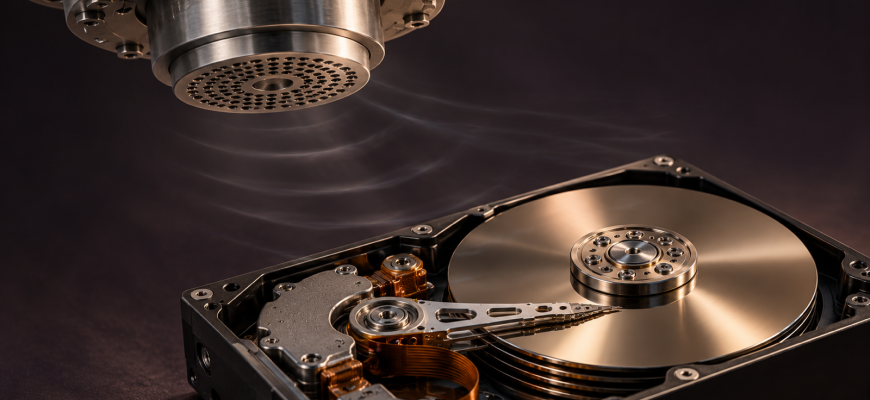
Magnetic hard drives position a read/write head over spinning tracks. That mechanical precision creates a vulnerability that solid-state storage does not share in the same way.
In its 2022 Silent Extinguishing white paper, Siemens reports tests of hard-drive sensitivity to noise and inert-gas discharge. The mechanism it describes is acoustic energy exciting vibration in the drive assembly, interfering with head positioning. A storage interruption therefore need not mean that water entered a chassis or that electricity disappeared.
The limits of that evidence matter. Siemens reports that neither data loss nor permanent HDD damage was observed in the actual discharge tests it describes. Its laboratory sensitivity results are not a universal failure threshold for every drive, rack or room. Frequency, enclosure acoustics and the installed equipment affect the result.
Noise-reducing discharge design addresses this particular coupling between suppression and storage. It does not establish that smoke, the original electrical fault or other incident damage is harmless.
Stopping the fire and restoring the service are different milestones
The physical outcome and the software outcome need separate confirmation. A server that stayed powered might have experienced storage errors. A server that lost power might require recovery of interrupted writes. A healthy machine in the same room might still be unavailable because a shared dependency stopped.
Euralarm’s guidance also treats reinstatement as a separate stage: equipment condition must be assessed, and an operated protection system may need recharge or restoration before its cover is available again. A successful reboot is not evidence that the room’s fire protection has been restored.
The most revealing incident record is consequently a chain of confirmed states: what detected the event, what released, what changed in power and cooling, and what the applications experienced. That chain explains how the servers behaved far more accurately than a single alarm label—and identifies what must be restored before normal operation resumes.
Sources
- Viking: Electric/Pneumatic Double-Interlock Preaction System — the specified release conditions.
- Johnson Controls: Fire Protection of Data Centers — protection technologies and differing asset risks.
- Euralarm: Selection of Fire Protection Systems for Data Centers — power, operation and reinstatement considerations, 2025.
- FSSA/FIA: Effect of High Airflow and Aisle Containment — industry-sponsored research report, 2023.
- Siemens: Silent Extinguishing — manufacturer testing and acoustic mechanisms, 2022.