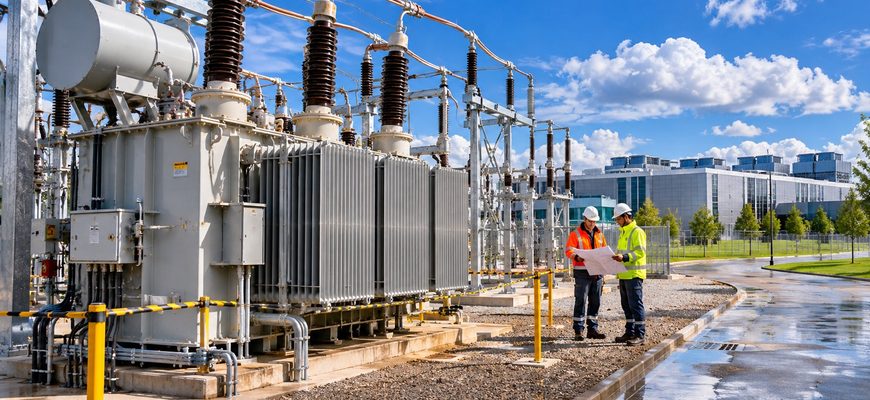
A power substation can need maintenance while the data center it serves remains full of running servers. Whether those servers stay online depends on the electrical routes available during the work—not simply on the number of generators parked outside the building.
A maintenance outage can be planned long before anyone opens a breaker. Grid operators, the utility, the data center’s facilities team and specialist contractors coordinate the work, but no generic answer fits every site. Some have two genuinely independent utility supplies. Others have two cables that converge at the same upstream equipment.
The first question: what exactly must be isolated?
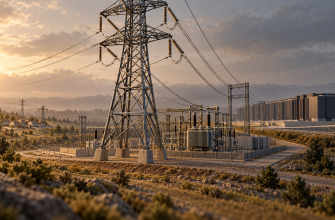
A substation contains transformers, switchgear, protection and control equipment. Some maintenance can be done on one isolated section while other equipment continues operating; other jobs require an interruption of the entire source path. The data center’s options depend on which part of its supply is affected and how those circuits are physically arranged.
One essential detail is often missing from an attractive redundancy diagram: two incoming feeds need not mean two independent upstream substations. An outage on their shared transformer, bus or protection system may affect both.
UPS batteries are a bridge, not a replacement substation
Uninterruptible power supplies can keep protected electrical loads energized while equipment changes source or generators start, within their designed capacity and runtime. They are not usually intended to supply an entire high-density campus for an indefinite maintenance period.
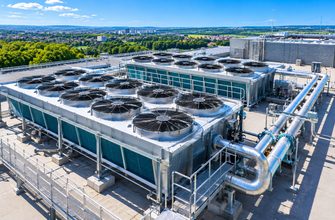
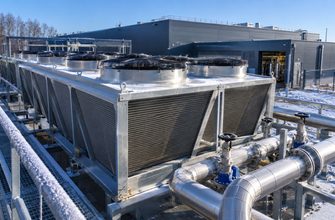
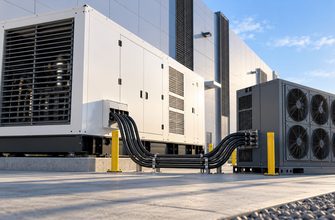
Standby generators may support sustained operation if the electrical design, fuel supply, emissions restrictions, maintenance state and cooling loads permit. Even then, the site must test that the mechanical plant, controls, pumps and network equipment have the required protected paths. Servers with power but without essential cooling are not a viable long-duration outcome.
Why two utility feeds may not be enough
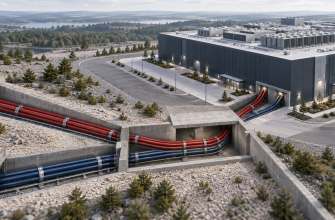
A facility with two utility connections can still have a common upstream dependency. Both lines might pass through one substation, one switching location or a limited set of protection components. The visible count of cables does not establish fault tolerance or concurrent maintainability.
The Uptime Institute Tier framework distinguishes facilities that can maintain infrastructure without affecting IT from those designed to tolerate specified faults. The standards address system outcomes, not a universal recipe requiring two particular utilities or one specific generator arrangement.
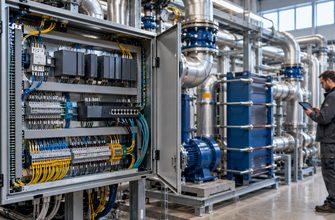
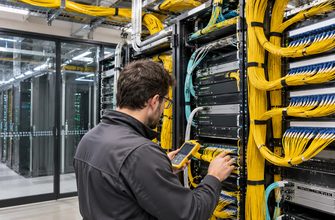
For maintenance planning, engineers trace the full path from utility supply to the racks, including transfer equipment, UPS distribution, busways and critical supporting systems. They also ask which components can be removed from service at the same time and which cannot.
What an operations team checks before the repair
- Actual electrical independence. Which circuits, transformers and substations are shared?
- Maintenance scope. Does isolation affect one feeder, the bus, protection equipment or all incoming supply?
- Backup capacity. What IT and mechanical loads must be sustained, and for how long?
- Standby readiness. Have applicable generators, fuel systems and transfer arrangements been tested under the intended load?
- Cooling continuity. Will pumps, fans, chillers and local control loops remain powered?
- Recovery route. What is the authorized plan if the alternate path develops a problem?
These are engineering review questions, not instructions to operate high-voltage switchgear. The actual transfer sequence belongs to qualified personnel following the approved site and utility procedures.
When the answer is yes—and when it is no
A data center with an independent surviving supply and the appropriate on-site distribution can remain online through some substation repairs. Another facility may run on backup generation for a planned interval. A third may have to schedule partial shutdowns or migrate workloads to another site before work begins.
Even a technically possible generator-backed maintenance window carries fuel, environmental and operational constraints. “We have generators” is not the same as “we can operate indefinitely without the grid.”
For related context, see IL.DIGITAL’s reporting on AI servers arriving before power infrastructure is ready and how synchronized AI workloads interact with power systems.
The operational goal is not to keep every wire energized. It is to make the maintenance boundary explicit, preserve a verified path for every critical load and avoid discovering a shared dependency after the utility equipment is already isolated.