- What Meta’s new network rack tells us
- Meta’s IcePack is a rack full of network switches
- Meta doubled its rated switch capacity
- Why GPUs need a network almost as carefully engineered as the GPUs themselves
- Where the packets actually go
- How two AI servers exchange information
- GPU server
- Network adapter
- Switching fabric
- Other GPU server
- Why a network switch generates so much heat
- Why liquid cooling changes the thermal design
- How liquid cooling removes heat
- Heat source
- Cooling interface
- Coolant loop
- What 102.4 terabits per second really means
- Capacity is not a benchmark
- Meta is changing how GPUs connect, too
- Why network failures matter so much
- Liquid cooling is a design choice, not a universal requirement
- What changes when a network rack is liquid-cooled?
- What Meta hasn’t published about IceCube’s thermal performance
- Known specifications versus missing measurements
- The experiment that would measure the value of a liquid-cooled AI network
- From traffic to heat and useful work
- AI infrastructure now has a second cooling story
- Sources and reporting notes
A modern AI data center already needs sophisticated cooling to keep its GPUs working. Now Meta is extending liquid cooling to another piece of equipment: the network switches connecting those machines.
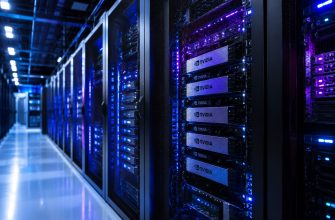
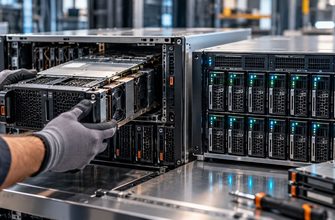
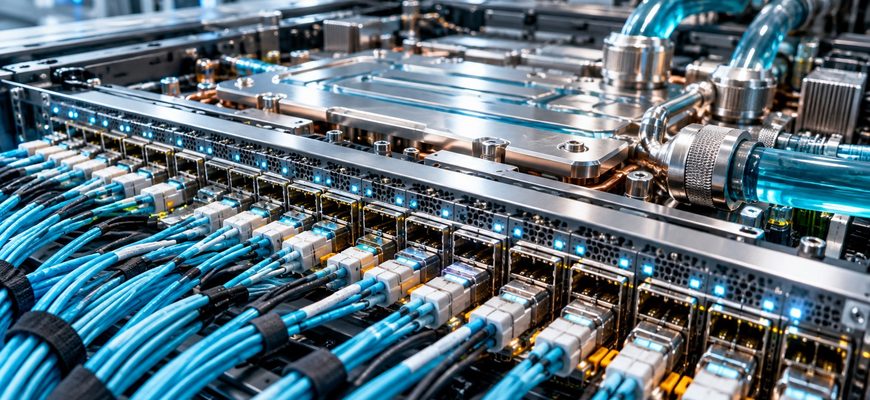
At the Open Compute Project Global Summit on October 12, 2026, Meta introduced IcePack, its first liquid-cooled networking rack. Inside it are IceCube switch blades with a stated switching capacity of 102.4 terabits per second.
These are not GPUs. The switches don’t generate AI responses or train models themselves. Their job is to move information between computing systems quickly and reliably.
So why does networking equipment need liquid cooling? The answer reveals a less visible constraint on AI infrastructure: as more accelerators work together, the network required to connect them becomes a major physical engineering challenge of its own.
Meta’s IcePack is a rack full of network switches
In its October 2026 engineering announcement, Meta described IcePack as its first generation of liquid-cooled networking infrastructure.
The rack follows the Open Compute Project’s ORV3-HPRv1 rack design and contains IceCube switch blades.
An IceCube blade is based on either Broadcom Tomahawk6C or NVIDIA Spectrum-6 switching silicon. Meta says both versions run its open-source FBOSS network operating system, using the OCP Switch Abstraction Interface.
The company’s published figures describe 128 ports operating at 800 gigabits per second, providing 102.4 terabits per second of aggregate switching capacity.
Compared with Meta’s preceding 51.2-Tbps platforms, that is a doubling of the published switching capacity.
Advertised aggregate capacity of one IceCube switch blade.
Published non-blocking port configuration.
Rated bandwidth compared with Meta’s earlier 51.2-Tbps platforms.
Meta’s open-source network operating system for the switch blades.
There is an important difference between this figure and the amount of data a real AI application will transfer.
The 102.4-Tbps number describes the switching platform’s aggregate rated capacity. It is not a measurement of training throughput, model performance or useful application payload delivered across an entire cluster.
Those results depend on the traffic pattern, the connected servers, network topology, congestion and other operational conditions.
Meta doubled its rated switch capacity
Why GPUs need a network almost as carefully engineered as the GPUs themselves
A single AI accelerator can do impressive work on its own. A large training system behaves differently.
During distributed training, accelerators exchange gradients, parameters and other intermediate information. In some model configurations, data also moves between devices during inference.
The accelerators cannot simply compute indefinitely while ignoring one another. Some operations require communication or synchronization before useful progress can continue.
When that communication takes longer than expected, expensive compute resources may spend more time waiting.
This is why a fast GPU does not guarantee a fast distributed training job.
Where the packets actually go
A GPU performing distributed work commonly communicates through a high-speed network interface. The interface sends information over electrical or optical links into a network fabric.
A switch receives incoming traffic, determines its destination and forwards it toward the appropriate device or another switch.
The switch therefore sits directly in the communication path between computing systems.
How two AI servers exchange information
GPU server
A distributed workload produces data that another machine needs.
Network adapter
A high-speed NIC prepares and transmits network traffic.
Switching fabric
One or more switches move traffic toward the destination.
Other GPU server
The receiving system can use the delivered information.
This physical network introduces several sources of delay: transmission time, switching, contention, congestion and possible retransmissions.
A larger link does not eliminate them all. Neither does a switch advertised with a very high aggregate capacity.
That is why operators monitor real network behavior instead of assuming that a fast specification automatically translates into fast model execution.
Why a network switch generates so much heat
A network switch is not just a passive junction between cables. Inside it are integrated circuits, signal-processing hardware, memory, power-conversion equipment and the interfaces required to move data.
Moving data at high rates consumes electrical energy. Much of the energy consumed by electronic equipment ultimately appears as heat that must be removed.
In conventional equipment, airflow can carry heat away from heat sinks and other internal components.
As designers pack higher-capacity switching electronics into increasingly dense systems, controlling temperatures using airflow alone can become more difficult.
More powerful fans are not a universal solution. Airflow depends on the chassis, obstruction, pressure drop and the available path through the rack.
Why liquid cooling changes the thermal design
Liquid cooling gives engineers another way to collect and transport heat away from concentrated electronic components.
In a typical direct-to-component liquid-cooling system, a cold plate transfers heat from a hot surface into circulating coolant. The warmed coolant then carries that energy to a heat exchange system.
The underlying physics is straightforward: the electronics consume electricity, heat is produced and a cooling system moves that heat somewhere else.
Meta has not provided a complete public breakdown of IceCube’s individual component temperatures, coolant flow rates or power consumption in the announcement. The precise thermal allocation inside each blade should therefore not be assumed.
How liquid cooling removes heat
Heat source
Switching electronics consume electricity and generate heat.
Cooling interface
A thermal interface and cooling hardware collect heat near critical components.
Coolant loop
Liquid transports captured heat toward the broader facility cooling system.
The idea may sound familiar from today’s liquid-cooled AI servers.
Our earlier story about heat removal inside a 135 kW AI rack explored how accelerator energy becomes a facility cooling problem.
IcePack extends that broader infrastructure discussion to the machines that connect those accelerators.
What 102.4 terabits per second really means
A terabit is one trillion bits. Network hardware specifications commonly express link rates in bits per second.
Meta’s IceCube specification can be understood through one piece of arithmetic.
This is the sum of the published port rates. It is the basis of the announced aggregate switching-capacity figure, not a measured transfer rate for an AI application.
Real delivered throughput is affected by protocol overhead, traffic distribution, the wider network and the workload.
Nor does the number say how many GPUs can be connected directly. That depends on network architecture, link allocation and topology.
A switch also needs to handle bursts, share resources and respond to congestion.
These factors determine whether the high-capacity hardware can deliver predictable performance under realistic load.
Meta is changing how GPUs connect, too
Hardware capacity is only one part of Meta’s October announcement.
The company also introduced a network topology called Flattened Planar Fabric, or FPF, intended to improve the performance and resilience of large GPU networks.
In the disclosed design, each GPU connects through eight independent 100G links to switches in eight distinct network planes.
Meta says its design reduces the traditional three-tier Clos fabric to two tiers and moves some traffic balancing into network-interface hardware.
This can reduce network hops and help make large training networks more resilient to individual failures.
It does not mean every distributed AI workload sees the same improvement. The outcome still depends on workload communication patterns and the whole network implementation.
Why network failures matter so much
Distributed computing ties together many individual machines.
If one path becomes congested or unavailable, the resulting delay can affect more than the packets traveling through that link. Workloads waiting for synchronization may lose useful computing time.
In its October 19 engineering report on the Prometheus supercluster, Meta stressed that issues on individual hosts can slow or interrupt large training jobs.
The broader engineering goal is to keep an enormous distributed system making progress instead of allowing small faults to waste expensive compute capacity.
Liquid cooling is a design choice, not a universal requirement
It would be misleading to conclude that every future networking switch must use liquid cooling.
Air-cooled switches still serve many real-world networks, and the cooling method depends on power density, chassis architecture, environmental limits and maintenance requirements.
Liquid cooling can make high-density deployments more practical, but also introduces equipment that must be designed, monitored and maintained.
Engineers need to account for coolant connections, pumps, heat exchangers, control systems and service procedures.
The relevant metric is not simply whether one piece of equipment runs cooler.
Operators need to know whether the complete networking and cooling system reliably handles the required traffic within its energy and thermal limits.
What Meta hasn’t published about IceCube’s thermal performance
The announcement provides useful information about the switch generation, network software and platform architecture.
But it does not include every measurement needed for an independent cooling-efficiency comparison.
In particular, the public engineering announcement does not provide a full measured power and thermal breakdown for an IceCube blade.
That prevents a defensible calculation of how much energy this specific switch consumes per transmitted bit during a production AI workload.
Nor should its 102.4-Tbps rated capacity be treated as continuously measured application traffic.
The experiment that would measure the value of a liquid-cooled AI network
A useful future test would compare networks that serve equivalent AI workloads while measuring switching performance, thermal behavior and total energy use.
The key is to avoid comparing switch specifications in isolation from real traffic.
AI infrastructure now has a second cooling story
The last few years have made GPU cooling a visible part of the AI infrastructure story. Dense accelerator racks draw significant power and require sophisticated systems to move their heat.
Meta’s IcePack shows that a similar engineering conversation now extends to the network connecting those racks.
This is not because the network suddenly performs the AI computation. It is because large-scale computation cannot function independently of the system that moves information between machines.
The next time a giant AI cluster is described by its number of GPUs, another useful question is how those GPUs communicate, how much energy the network consumes and where its heat goes.
Sources and reporting notes
This article relies on manufacturer disclosures and published Open Compute Project material. il.digital did not independently measure IcePack, IceCube or a production AI network fabric.
- Engineering at Meta — OCP Summit 2026: Powering AI with Open Innovations in Scale-Up, Scale-Out and Scale-Across Networks . October 12, 2026.
- Open Compute Project — 2026 OCP Global Summit by the Numbers . October 21, 2026.
- Engineering at Meta — Inside Prometheus: Meta’s Journey to a Gigawatt-Scale Supercluster . October 19, 2026.
- Open Compute Project — Breaking Through the AI Network Wall with High-radix Switching . July 28, 2026.
- NVIDIA — Network Logical Architecture, HGX AI Factory Reference Design . Technical background on AI compute fabrics.