Two years underwater.
No technicians.
Microsoft sealed an entire datacenter inside a steel cylinder and lowered it into the sea. When engineers brought it back, the most surprising result was not that it survived.
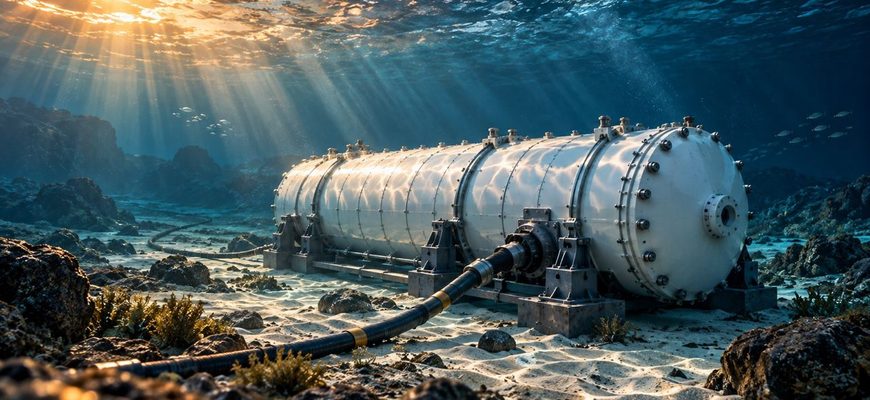
In the spring of 2018, a white steel cylinder disappeared beneath the cold water off Scotland’s Orkney Islands.
Inside were 864 servers.
There were no aisles for technicians. No maintenance room. No carts loaded with replacement drives. No possibility of opening a cabinet because a machine had started behaving strangely.
Once the hatch was sealed and the module reached the seabed, the computers were on their own.
Microsoft called the experiment Project Natick.
The Datacenter That Could Not Be Repaired
Northern Isles, the second major Project Natick prototype, was roughly the length of a shipping container.
Inside its pressure vessel sat 12 server racks holding 864 standard datacenter servers and about 27.6 petabytes of disk storage.
Then Microsoft sealed them inside.
A Failed Server Could Stay Failed
From the moment the vessel reached the seabed, the basic maintenance philosophy changed.
If one machine failed, nobody opened the module to repair it. The failed machine simply stopped contributing to the system.
The rest of the infrastructure continued working.
The architecture had to tolerate losing individual machines rather than depending on immediate physical intervention.
That changes what a datacenter needs to be.
Underwater Did Not Mean Wet Electronics
The servers themselves never sat in seawater.
They operated inside a dry, sealed pressure vessel filled with nitrogen. Internal cooling moved heat away from the machines and ultimately rejected it into the surrounding sea.
The ocean was the heat sink — not the server room.
Then the Cylinder Came Back
After roughly two years, Microsoft recovered Northern Isles from the seabed.
Its exterior was no longer clean white steel. Marine organisms had colonized parts of the module and its ballast structure.
The vessel was cleaned, transported ashore and opened. Engineers sampled its internal atmosphere and began examining the hardware.
Instead, one of the most provocative results concerned something much more ordinary: server reliability.
Microsoft reported an underwater failure rate equal to roughly one-eighth of its land-based control group. This is a normalized rate comparison, not a literal count of one failed server versus eight.
Why Did the Underwater Servers Fail Less Often?
The result did not prove that seawater makes computers more reliable. The seawater never touched them.
Researchers instead focused on two unusual properties of the environment inside the module.
Northern Isles did not contain ordinary humid air. Its sealed atmosphere was dry nitrogen.
Reducing oxygen and moisture can reduce some corrosion mechanisms affecting electronic hardware.
Nobody moved racks, reseated cables, opened enclosures or bumped components during the deployment.
Researchers considered that absence of physical intervention another possible contributor.
The Strangest Part of Natick May Not Have Been the Ocean
Imagine removing the sea from the experiment.
What remains is a tightly controlled atmosphere, predictable thermal conditions, no technicians touching hardware and a system designed to tolerate individual failures rather than repair them immediately.
The ocean forced Microsoft to remove a basic assumption of conventional datacenter design: that humans must always be able to walk in and fix something.
So Why Aren’t Microsoft’s Datacenters on the Seabed Now?
Because proving that something works is not the same as proving that it is the best way to build infrastructure at enormous scale.
A failed individual server may be tolerable. A failed shared cooling system is different. So is damage to subsea power or network infrastructure.
Hardware upgrades become harder when the equipment sits inside a sealed pressure vessel.
Recovery requires ships, marine equipment, logistics and suitable conditions.
And computing hardware evolves quickly. A system expected to remain untouched for years must remain useful long enough to justify the deployment model.
Microsoft later confirmed that Project Natick was no longer an active program and that the company was not building commercial subsea datacenters.
The lessons didn’t.
Natick was not a blueprint for putting every datacenter underwater. It was a way to expose assumptions about cooling, maintenance, physical access and reliability.
Project Natick began with a spectacular image: a datacenter sitting on the bottom of the sea.
But its most interesting result came from inside the cylinder.
The experiment removed technicians, ordinary air and the expectation of immediate repair.
Then it discovered that the machines failed less often.
That does not mean the future of cloud computing is underwater. It suggests something subtler.
Many assumptions in computing infrastructure exist because of the way humans traditionally build and maintain machines — not necessarily because the machines themselves require them.
Sometimes the most useful experiment is to remove an assumption entirely and see what survives.
Microsoft removed the door. For two years, nobody could walk through it. And the computers seemed to like that.