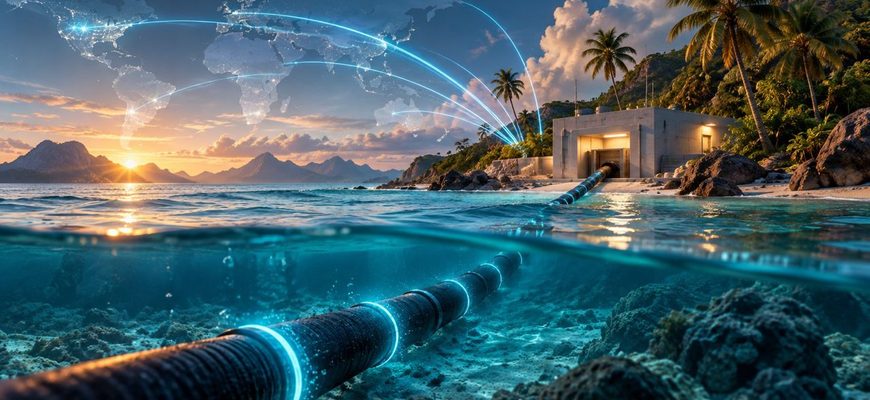
On an island, the internet has a shoreline.
In Tonga, that shoreline is part of a much larger system stretching beneath the Pacific. Fiber-optic cable crosses the seabed, approaches land through carefully surveyed coastal waters, and eventually connects to terrestrial networks that carry traffic toward homes, hospitals, schools, businesses and government offices.
For most internet users, none of this is visible. A message appears to move directly from a phone to another screen somewhere overseas. A video call seems to cross the Pacific without geography. Cloud services feel placeless.
But island connectivity is intensely physical. Distance matters. Seabed conditions matter. Ports, permits and repair ships matter. Above all, the number of independent routes off an island matters.
Tonga offers an unusually clear view of that reality. Its first international submarine fiber connection became commercially operational in 2013, linking the kingdom to Fiji. The cable brought far greater capacity than the satellite-dependent system that preceded it. It also made one piece of infrastructure extraordinarily important.
Years later, a volcanic eruption and tsunami would demonstrate what that dependence meant.
- Before the cable, distance had a price
- A cable landing is a beginning, not an endpoint
- When bandwidth becomes less scarce
- The hospital is part of the cable story
- Then the ocean moved
- The single-cable problem
- Why not simply build another cable?
- The landing station changes the map
- Redundancy is not the same as duplication
- Satellites change the resilience equation
- The next islands to come ashore
- The internet is global because it is local somewhere
Before the cable, distance had a price
Tonga consists of islands scattered across a large area of the South Pacific. Geographic isolation is part of everyday life, but in telecommunications it creates a specific economic problem: connecting a small population across a vast ocean can be expensive.
Before the international fiber link, satellite capacity played the central role in Tonga’s external connectivity. An environmental assessment prepared for the Fiji–Tonga cable project described international connectivity as a major constraint and noted that satellite-based communications provided relatively limited and costly capacity compared with the fiber infrastructure being proposed.
The alternative was to connect Tonga physically to the wider submarine cable network.
The resulting Tonga–Fiji system ran roughly 827 kilometres and connected Tonga through Fiji to larger trans-Pacific infrastructure. The cable landed in Tonga in June 2013 and became commercially operational that August, according to World Bank project reporting.
That distinction—between a satellite link and a physical fiber route—is important. Submarine fiber can provide enormous capacity with low latency over international distances. Once the expensive international link exists, operators can expand broadband services without buying every additional increment of international traffic through the same satellite economics that constrained earlier networks.
But a cable landing does not automatically create cheap or universal internet.
A cable landing is a beginning, not an endpoint
It is tempting to imagine a submarine cable as a giant broadband pipe: connect an island and abundant internet simply flows into it. The real system has more layers.
The submarine segment must reach a landing point. From there, traffic has to enter terrestrial networks. Operators need access to capacity. Mobile and fixed networks must reach users. Regulators determine the conditions under which companies compete. Electricity has to remain available. Equipment must be maintained.
And an island’s internal geography can reproduce the same connectivity problem on a smaller scale.
Tonga’s original international connection reached Tongatapu, the main island. Connecting outer island groups required another infrastructure project. A later cable extension was designed to link Ha’apai and Vava’u into the network, creating submarine connections within the country as well as the international connection beyond it.
The path of an ordinary internet request can therefore cross several distinct systems:
- A phone or computer connects to a local fixed or mobile network.
- Domestic infrastructure carries the traffic toward an international gateway.
- A cable landing station connects terrestrial infrastructure to the submarine system.
- The submarine cable carries traffic toward another country or network hub.
- From there, interconnected networks carry it toward its destination.
Each layer can have different owners, economics and points of failure.
That is why the arrival of a cable is not merely a construction story. It changes the structure within which a country’s internet market operates.
When bandwidth becomes less scarce
The development case for island submarine cables rests partly on a simple proposition: international bandwidth should stop being an unusually scarce resource.
After Tonga’s cable became operational, World Bank project reporting noted substantial growth in broadband demand, particularly in mobile broadband. The original project also combined physical infrastructure with regulatory reforms rather than treating the cable as an isolated engineering investment.
This matters because wholesale international capacity is only one component of the price and quality experienced by a household. Competition between operators, domestic network coverage, taxation, equipment costs and the structure of the wholesale market all influence the final service.
A landing station can therefore alter the possibilities available to a country without guaranteeing the outcome.
The International Telecommunication Union has made a similar point in its work on Small Island Developing States: submarine fiber can dramatically increase available international bandwidth, but infrastructure must be accompanied by conditions that allow people and businesses to use it.
The hospital is part of the cable story
The effects become easier to understand when the cable is followed beyond the telecommunications sector.
When Tonga’s fiber connection was being introduced, the country’s health sector was already considering how better connectivity could support communication between medical workers on different islands and specialists overseas. For a remote health system, moving information can sometimes substitute for moving a person.
A specialist does not become physically closer when a cable lands. But scans, consultations, video and medical information can travel differently.
The same logic applies elsewhere. Students can reach educational material hosted overseas. Government systems can exchange data more reliably. Tourism businesses can communicate with customers and booking platforms. Families separated by migration can use video rather than voice alone.
These are not separate benefits floating above the infrastructure. They are consequences of changing the cost, capacity and reliability of moving information across an ocean.
Then the ocean moved
Fiber solved one problem for Tonga. It also concentrated enormous importance in a physical route across a geologically active ocean.
In January 2022, the Hunga Tonga–Hunga Ha’apai volcanic eruption and tsunami caused widespread destruction. The country’s main international submarine cable was severed in at least two places. At the time, it was Tonga’s only submarine cable connection to the outside world.
The effect exposed something that normal operation had hidden: a nation’s apparently intangible connection to the global internet could be interrupted by damage to infrastructure lying on the seabed.
Satellite systems became essential to the emergency response. The ITU worked with Tonga and partners to provide temporary satellite bandwidth, terminals and satellite phones while the damaged infrastructure was being restored.
The episode should not be read as evidence that submarine fiber is inherently fragile or that satellites are a straightforward replacement. It demonstrates something more useful: capacity and resilience are different properties.
A cable can deliver enormous capacity and still represent a serious national vulnerability if there is no sufficiently independent alternative route.
The single-cable problem
Submarine cable faults are routine at the scale of the global network. The ITU says more than 170 cable repairs were reported worldwide in 2025. Fishing and anchoring are major causes of damage, while earthquakes, submarine landslides, storms, currents and equipment failures can also affect systems.
For a well-connected continental market, a single damaged cable may be largely invisible to users because traffic can be rerouted across other systems.
For an island with one principal international fiber route, the same physical event can have national consequences.
This is the central distinction in island connectivity: the relevant question is not simply whether a country has a submarine cable. It is whether the country has genuinely diverse ways to remain connected when one route fails.
| Network condition | Normal operation | After a major cable fault |
|---|---|---|
| Single submarine route | High-capacity international connectivity | Potentially severe disruption unless backup capacity is available |
| Multiple geographically diverse cables | Capacity distributed across routes | Traffic may be rerouted, subject to remaining capacity |
| Fiber with satellite backup | Fiber handles most high-volume traffic | Satellite can preserve critical connectivity, but may not replace all lost fiber capacity |
The word diverse is crucial. Two cables do not necessarily provide meaningful redundancy if they share the same landing site, coastal corridor or hazardous seabed route. A single event can affect infrastructure that appears separate on a network diagram.
Resilience therefore has a geographic dimension.
Why not simply build another cable?
For large markets, redundancy can be commercially attractive. Multiple operators need capacity, data centres generate traffic, and international routes can serve millions of paying customers.
Small islands face a different calculation.
A submarine cable requires large upfront investment regardless of whether the landing country has one million potential customers or a fraction of that number. Routes must be surveyed. Cable must be manufactured and laid. Landing infrastructure must be built. Permits must be secured. The system must then be operated and maintained for years.
Adding a second geographically independent system improves resilience, but the additional route must still be financed.
This creates an uncomfortable infrastructure equation: the places where redundancy can be most socially important may be among the places where redundant infrastructure is hardest to justify through commercial demand alone.
The issue is significant enough that the ITU’s International Advisory Body on Submarine Cable Resilience specifically recommends financing structures for Small Island Developing States and other underserved regions. Its recommendations include blended finance, public-private partnerships, predictable permitting, route diversity and mechanisms that can make projects viable where purely commercial investment may not be sufficient.
This is where the story of island internet stops being purely technical. Someone has to decide how much resilience is worth paying for, who should pay for it and which risks justify duplicating infrastructure.
The landing station changes the map
A cable landing point is a peculiar kind of geography.
Before a cable arrives, a beach or coastal site may have little relationship to the global flow of data. Afterwards, infrastructure near that shoreline can become part of a route carrying communications between the island and the rest of the world.
That creates operational and policy questions that are easy to miss when connectivity is measured only as national bandwidth.
Who can access capacity at the landing station? Can competing carriers connect on reasonable terms? Is there more than one terrestrial route away from the coast? Are backup power systems adequate? Are repair procedures and permits prepared before a fault occurs? Does a second cable actually follow a separate geographic path?
The ITU’s resilience recommendations include non-discriminatory access to cable landing stations, where consistent with national regulation and security requirements, as one mechanism that can support competition and reduce wholesale costs in underserved regions.
The physical landing, in other words, can influence the structure of the market above it.
Redundancy is not the same as duplication
One of the easiest mistakes in infrastructure planning is to count connections rather than examine them.
A country may have two international links and still possess a shared point of failure. Cables may enter through the same coastal area. Domestic backhaul may converge on one facility. Backup systems may have too little capacity to carry essential traffic during a prolonged outage.
Resilience requires looking at the whole path.
- Route diversity: independent submarine paths should avoid unnecessary exposure to the same hazards.
- Landing diversity: separate coastal locations can reduce dependence on a single site.
- Domestic diversity: traffic needs resilient routes from landing infrastructure into population centres.
- Power resilience: telecommunications equipment remains dependent on electricity and backup systems.
- Repair readiness: cable ships, permits, spare equipment and cross-border coordination affect how quickly physical service can be restored.
- Alternative technologies: satellite connectivity can preserve essential communications when terrestrial or submarine infrastructure is unavailable.
None of these measures eliminates failure. The goal is to prevent one failure from becoming a national communications crisis.
Satellites change the resilience equation
The relationship between islands, fiber and satellites is also changing.
Historically, satellite connectivity was often the expensive, capacity-constrained system that submarine fiber projects sought to supplement or displace. Modern satellite systems have made the distinction less simple.
For many island networks, the useful model is not fiber or satellite. It is fiber for large-scale everyday capacity combined with alternative connectivity that can continue operating when the primary physical route is unavailable.
The Tonga disaster illustrated the value of that combination. Temporary satellite links could restore essential communications while cable infrastructure was being repaired.
But backup has practical limits. Emergency connectivity does not necessarily reproduce the capacity, economics or network performance of the system it replaces. A link adequate for government coordination, humanitarian operations and priority communications may not support normal national traffic at normal service levels.
Resilience planning therefore requires deciding what must remain online during a failure—not merely identifying a second technology.
The next islands to come ashore
The same infrastructure calculation is playing out across the Pacific.
Projects have connected or are connecting island states that once depended heavily on satellite systems to regional and international submarine networks. In the Federated States of Micronesia, for example, connectivity programs have combined submarine cable infrastructure with satellite links, while the East Micronesia Cable system is intended to improve connectivity across parts of Micronesia, including connections benefiting Kiribati and Nauru.
Each project has its own economics and politics. But the underlying challenge is shared.
Small populations need access to the same increasingly data-intensive global services as large ones. Geography makes that access unusually expensive to build. Climate and geological hazards can make infrastructure difficult to protect. Commercial returns may not justify the level of redundancy that national resilience demands.
That is why island networks reveal so much about the internet as a whole.
The internet is global because it is local somewhere
The phrase “global internet” encourages a view from above: continents connected by lines, information moving between abstract nodes, distance collapsing into milliseconds.
At a cable landing, the perspective is reversed.
The global network becomes a local object. It crosses a beach. It enters a building. It depends on electricity, roads, technicians, regulation and ships capable of repairing fiber on the ocean floor.
For an island, the consequences of that physical connection can extend far beyond faster downloads. International bandwidth can change what hospitals can transmit, how schools reach information, how businesses interact with distant markets and how families communicate across migration routes.
But every new dependency also creates a resilience question.
Tonga experienced both sides of the transformation. Fiber reduced the communications penalty imposed by distance. Then a natural disaster revealed the significance of depending heavily on a single physical connection.
The lesson is not that islands should distrust submarine cables. Quite the opposite: fiber has become foundational infrastructure for modern connectivity.
The lesson is that reaching an island is only the first stage.
The harder task is building a network that can keep reaching the rest of the world when something breaks.