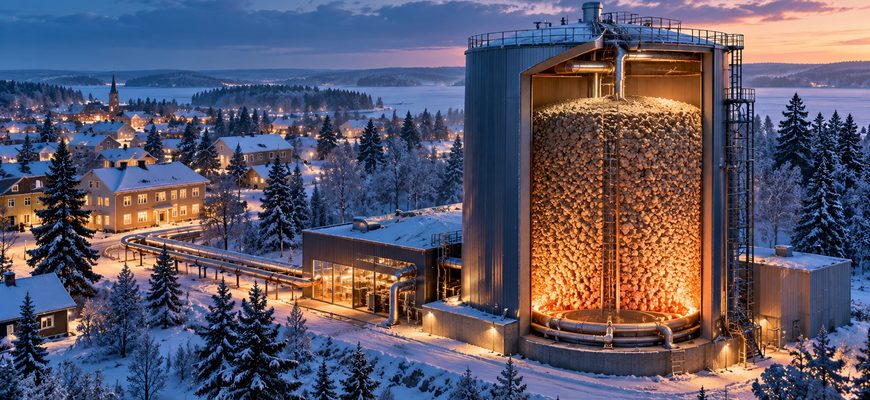
- First, it isn’t really sand.
- How do you charge a sand battery made of rock?
- A year later, what actually changed?
- The biggest misunderstanding: 100 MWh is not 100 MWh of electricity
- What the system does
- What it does not do
- Could the same rock someday give electricity back?
- From fireplace waste to a town’s heating system
- Three quick questions
- The surprising part isn’t the rock.
- Sources & reporting notes
A warmer town.
In Finland, a giant insulated tower is helping heat public buildings. A year after it started working, there is a much more interesting question than “Can a battery be made of sand?”
You don’t usually think of a pile of crushed stone when you turn on the heating. But in the Finnish municipality of Pornainen, that ordinary material is at the center of an unusual energy experiment that has already moved beyond the experimental stage.
The town’s sand battery is a huge insulated store of heat. Electricity warms crushed rock inside the structure. Later, that stored heat can help warm water circulating through a local district-heating network.
It opened in June 2025. In June 2026, the company behind it reported that emissions from the local district-heating network had fallen by 70% during the battery’s first year. That is a company-reported figure, not an independent measurement by il.digital—and it does not mean the town’s total emissions fell by 70%. Read the one-year report.
So what actually sits inside this giant battery? How does it keep heat until people need it? And why doesn’t every cold-weather town build one?
First, it isn’t really sand.
Despite the name, the Pornainen sand battery contains about 2,000 metric tons of crushed soapstone—a dense rock often used in heat-retaining fireplaces. The material came from by-products of Finnish fireplace manufacturer Tulikivi’s production process, rather than from a beach or a desert.
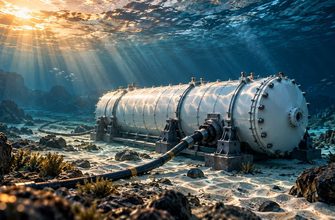
The sand battery itself is approximately 13 meters tall and 15 meters wide. From the outside, it is closer to a compact industrial silo than anything you would put in a garage. Inside is a large mass of solid material, surrounded by insulation and connected to equipment that moves heat into and out of the store.
Specifications from the project’s published technical overview. MWh here measures stored heat, not electricity delivered to the power grid.
There is nothing magical about the rock. If you have ever felt the warmth radiating from paving stones after sunset, you know the basic idea: solid materials can hold heat and give it back later.
The hard part is doing that reliably at the scale of a community heating system, controlling when energy enters and leaves, and limiting the heat lost along the way.
How do you charge a sand battery made of rock?
Think of the sand battery as a giant reusable hot-water bottle—but one that stores heat in solid material and works with a district-heating network instead of resting under a blanket.
When electricity is available at a favorable price, the system uses it to produce heat. The heat travels through a closed-loop transfer system and warms the crushed stone. Insulation slows its escape. When the neighborhood needs warmth, the system transfers stored heat into the heating network.
The important detail is timing. Heat demand and electricity prices do not have to rise and fall together. A town may need heat on a dark evening even though electricity was cheaper earlier in the day. Storage helps separate the moment energy is bought from the moment it is used.
That flexibility matters more than the novelty of the filling material. A heap of rock alone does not solve an energy problem. A well-insulated, controllable thermal store connected to the right heating network might.
This battery does not power televisions or charge phones. It stores heat for buildings. Calling it a “battery” describes its job as an energy store, not its output as electricity.
There is also a practical difference from heating every room separately. In district heating, one central source supplies hot water through insulated underground pipes to connected customers. Schools, libraries and other public buildings can use heat delivered by the network without each needing an industrial thermal store of its own.
A year later, what actually changed?
In June 2026, Polar Night Energy published a first-year account of the installation, built for local heat provider Loviisan Lämpö. It said the sand battery had become the main source of heat for the Pornainen district-heating network and had met its operating targets.
The figures are substantial. They also need to be read carefully.
Source: Polar Night Energy, 11 June 2026. These are reported results from the project participants. il.digital has not audited the measurement data or a before-and-after emissions inventory.
The operator also reported no interruptions to district-heating delivery during the first year. That does not make the battery immune to faults. It means the combined heating arrangement—including its other equipment—reportedly kept supplying customers over that period.
Among the connected customers are local public buildings, including a school, municipal offices and a library. That makes the project less abstract than another battery announcement: the output is warmth in places people actually use.
There is another reason the sand battery can work for a town like this. According to the project developer, it charges at times chosen to make use of lower electricity prices. The same June 2026 update says the investor was able to buy charging electricity considerably below average spot-market prices. That is a statement about this operating arrangement, not a guaranteed saving for every site or every year.
The biggest misunderstanding: 100 MWh is not 100 MWh of electricity
You will often see two numbers quoted for the Pornainen sand battery: 100 megawatt-hours of storage and 1 megawatt of heating power. They sound similar, but they describe different things.
Capacity tells you how much energy the battery is designed to hold. Power tells you how quickly it can deliver heat. Imagine a water tank: the tank’s size is capacity, while the width of its outlet affects how quickly the water can flow.
A simple piece of arithmetic makes the difference clearer. A fully charged 100 MWh heat store delivering a constant 1 MW would last 100 hours—just over four days—in an idealized calculation. This is not a prediction of the plant’s operating schedule: usable energy, changing demand, heat losses and the way the site is operated all affect the result.
The developer says the store’s capacity is roughly equivalent to a week of the local network’s heat demand in winter or almost a month in summer. That is possible because a district’s heating needs are not constant. It also refers to connected district-heating loads, not every home and building in the municipality.
What the system does
It shifts heat production to a more convenient time, stores thermal energy in low-cost solid material, and supplies a network that already knows how to distribute hot water.
What it does not do
It does not create free energy, guarantee renewable electricity at every charging hour, or turn stored heat back into grid electricity in the Pornainen installation.
It also needs a surrounding system: insulation, heating equipment, controls, pumps, pipes and an electricity supply. And some heat is inevitably lost. The question is whether the project saves enough on fuel, emissions and operating costs to justify building and maintaining that infrastructure.
That is why a sand battery is more compelling for district heating and industrial heat than for a single ordinary home. Large users can spread the cost of the equipment over a substantial, relatively predictable need for heat.
Could the same rock someday give electricity back?
Not through this sand battery. Pornainen’s installation is designed to return useful heat. Turning heat back into electricity adds another conversion step, and a portion of the energy is lost in that process.
That has not stopped researchers from trying. In an April 2026 report, Live Science visited Polar Night Energy in Finland and described a separate pilot in Valkeakoski. That experimental design aims to explore converting stored heat into electricity as well as useful heat.
The company discussed a projected electrical conversion efficiency of roughly 30–35% for that pilot, but a projection is not a demonstrated operating result. Its economic prospects also remain uncertain. There is a genuine difference between a system already supplying district heat and one still trying to prove a new kind of output.
This distinction matters because the temptation is to imagine a universal rock battery that solves every storage challenge. The more interesting—and more credible—future might be a collection of different technologies doing different jobs: chemical batteries when we need electricity back, thermal stores when we mainly need heat, and other systems where their particular strengths make sense.
From fireplace waste to a town’s heating system
The sand battery becomes even more interesting when you follow the material rather than the electricity. The crushed soapstone was a by-product of making heat-retaining fireplaces. Instead of being discarded, it became the central thermal mass of a large energy store.
It is a neatly circular idea, but the story should not be oversold. Reusing a by-product does not automatically make the entire heating system emissions-free. What matters is the electricity used, the fuels displaced, the life of the equipment and the full balance of costs and emissions.
The timeline shows how quickly a peculiar-sounding concept became an operating local utility:
- 2022 · An earlier working exampleA smaller sand battery began operating in Kankaanpää, Finland, showing that thermal storage could be connected to a local heat network.
- June 2025 · A much larger installation opensThe 100 MWh Pornainen store, about ten times larger than the earlier example, begins supplying Loviisan Lämpö’s local district-heating system.
- April 2026 · A different experiment takes shapeReporting from Finland describes a separate pilot exploring whether heat storage might also supply electricity.
- June 2026 · First-year resultsPolar Night Energy reports a 70% drop in local heating-network emissions, alongside reductions in biomass and oil use.
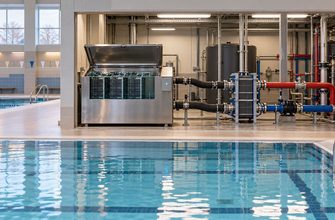
There is an instructive parallel with another physical technology story we’ve covered at il.digital: the swimming pool warmed partly by heat from a data centre. In one case, computers produce heat that someone else can use. In the other, electricity creates heat deliberately so it can be used later. Both stories ask the same deceptively simple question: where should the heat go?
The surprising part isn’t the rock.
The rock is easy to understand. Warm something heavy, insulate it, and let it cool slowly.
The breakthrough is making that simple idea behave like useful public infrastructure: charging when electricity is advantageous, delivering warmth when buildings need it, and doing so reliably enough that a town can depend on the system.
One year in, the Pornainen results suggest that this particular sand battery is doing exactly that. The bigger question is where else the economics, electricity supply and heating demand line up as well.