- Key Takeaways
- The revealing detail is three metres
- Follow the heat out of the machine
- A warm pipe is only half a heating system
- Good heat capture. Two different outcomes.
- Three percentages can tell three different stories
- Free to the pool still means someone pays
- Ask for the year, not the best afternoon
- The building becomes part of the computer’s design
Exmouth, Devon · Heat reuse
At Exmouth Leisure Centre, part of the pool’s heating system has another job: running computers.
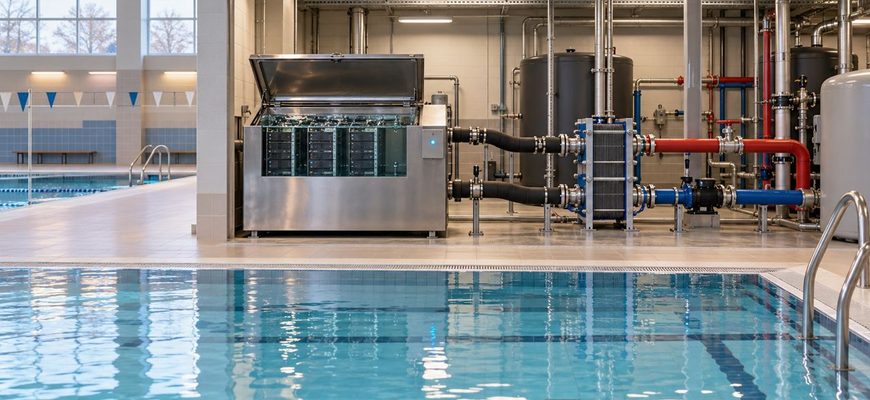
In 2023, Deep Green installed a small data centre at the Devon leisure centre. Its servers sat in oil that carried their heat into the pool’s heating system. A machine that would normally need help getting rid of heat had been placed beside a building that needed to buy it. Devon’s climate partnership documented the installation.
The arrangement sounds almost too tidy. Rent out computing, collect the heat and let people swim in the benefit. But a working installation has to reconcile two very different demands. Computing customers want dependable machines. The pool wants dependable warmth. Their needs can coincide without following the same timetable.
The difficult part begins when the pool has enough heat and the computers still have work to do.
01 · The connection
The revealing detail is three metres
In an April 2023 interview with CIBSE Journal, Deep Green’s founder described the Exmouth pipe connection as only three metres from the computers. The same account describes oil carrying heat through an exchanger to warm pool water.
Three metres changes the scale of the problem. This is a local plumbing connection, with a heat customer already on the premises. The distance between producer and user becomes part of the computing infrastructure.
A heat exchanger transfers energy across a separating surface. The oil and pool water remain in separate circuits; swimmers are not sharing water with the electronics. The schematic below follows the heat, rather than showing the full plumbing installation.
Physical layer
Follow the heat out of the machine
- 01 → Servers Electrical power runs computing equipment and becomes heat.
- 02 → Cooling oil Liquid collects heat from the immersed equipment.
- 03 → Heat exchanger Heat crosses a barrier. The fluids stay separate.
- 04 Pool heating The receiving circuit carries useful warmth to the pool.
A warm pipe is only half a heating system
Heat has a temperature as well as a quantity. A large supply can be awkward to use if it is too cool for the receiving system. A nearby demand can be equally awkward if it disappears when the servers are busiest.
The US Department of Energy’s data centre design guide identifies nearby heat users and compatible temperatures as favourable conditions for reuse. It also describes backup cooling for periods when the heat user is unavailable.
This gives a better way to judge the idea than counting servers. Ask how much heat reaches the customer, at what temperature, and during which hours. Increasing the size of the data centre cannot, by itself, increase the building’s appetite for warmth.
An illustrative heat balance
Good heat capture. Two different outcomes.
Assume a system produces 100 kWh of heat during a chosen interval and makes 90 kWh available after capture and transfer losses. These are invented teaching inputs, not measurements from Exmouth. Open each scenario.
The building needs 90 kWh
With matching temperatures and timing, all 90 kWh available can be useful.
The building needs only 40 kWh
Only 40 kWh is immediately useful. The remaining 50 kWh of available heat needs another user, storage or rejection through cooling equipment.
Both scenarios assume no heat pump, no storage and the same interval. Useful heat = the smaller of available heat and compatible heat demand. Auxiliary electricity is excluded.
02 · Reading the claims
Three percentages can tell three different stories
East Devon District Council’s launch announcement described an installation with 12 servers. It cited approximately 96% heat recycling and forecast a 62% reduction in the pool’s gas requirements. Those percentages have different denominators. Neither should be read as a measured reduction in all energy used by the leisure centre. The council’s announcement sets out the claims.
The evidence reviewed here establishes the project and its proposed benefits. It does not provide an independently audited, full-year heat-and-gas dataset establishing those forecasts as achieved results.
| Measurement | The question it answers | What it cannot establish alone |
|---|---|---|
| Heat captured | How much heat leaves the computers through the recovery system? | Whether anyone uses that heat. |
| Useful heat delivered | How much does the receiving system actually accept? | How much fuel or money is saved. |
| Fuel displaced | How much less fuel is needed against a comparable baseline? | The net carbon impact of the complete arrangement. |
Measurement framework, not reported Exmouth results. Baselines must account for changes in operations and heating conditions.
Free to the pool still means someone pays
Deep Green’s current offer to heat hosts says it covers data centre capital and operating costs, offers heat without charge and uses backup cooling when it produces more than a host needs. Its site assessment includes power, fibre, space and heat demand.
This is a business arrangement as well as an engineering one. A heat bill can disappear for the recipient while electricity, equipment and maintenance remain real costs elsewhere. A sensible assessment follows those costs across both parties.
The same applies to carbon. Replacing some boiler heat can be beneficial, but the calculation still needs the electricity supply, additional pumping and cooling, and a credible comparison for where the computing would otherwise run. More heat is not automatically a better result if producing it requires unnecessary computation.
Exmouth’s own wider heating plan illustrates the limits of one solution. Council meeting minutes from April 2023 discussed Deep Green alongside possible heat pumps and retaining boilers for domestic hot water. Heating the pool does not settle every thermal requirement in the building.
03 · The useful neighbour
The building becomes part of the computer’s design
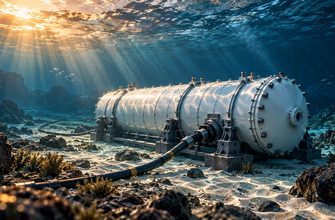
Our Project Natick case study examined what happens when a data centre is placed in the sea. Exmouth brings the question back onto land: who could use what the machine normally throws away?
That question changes site selection. A cheap room with excellent connectivity may have no heat customer. A building with a useful thermal demand may lack electrical capacity, access or the right network connection. The best match has to work for both services.
At Exmouth, the interesting connection runs a few metres through a plant room. Follow it in one direction and you find computers that need cooling. Follow it in the other and you find people who need warm water. The engineering succeeds where those two needs meet.