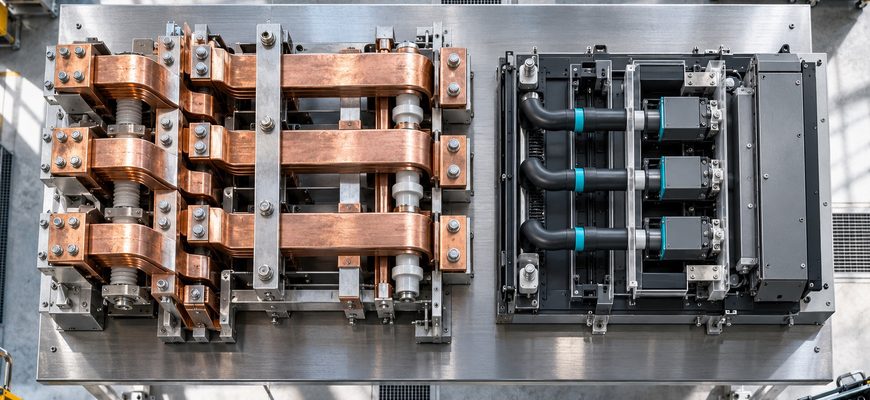
- What the 800-volt transition actually changes
- The problem starts with current, not voltage
- What happens at 100 kilowatts?
- Nearly 15 times less current
- A GPU does not need 800 volts. The power distribution system might.
- The new path from the facility to the GPU
- Facility electrical supply
- 800 VDC distribution
- Local voltage conversion
- Data centers will not replace every power system overnight
- The near-term approach: convert power beside the servers
- The longer-term approach: change the data hall
- Higher voltage solves one problem and makes another harder
- Less current to distribute
- More demanding fault protection
- 800 volts cannot create electricity that the data center does not have
- What should engineers measure before calling 800 VDC more efficient?
- Test the whole power path, not just the voltage
- The next AI infrastructure challenge may be inside the power cabinet
- Sources and reporting notes
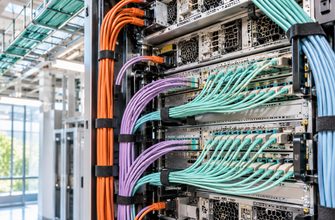
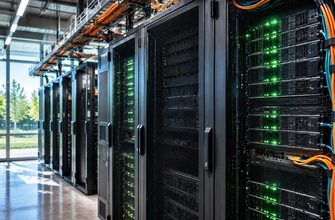
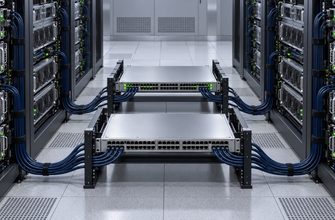
Imagine installing a new AI computing rack in a data center. There is enough floor space. The servers have arrived. The cooling system has been designed. But before a single GPU can begin working, somebody has to solve a surprisingly difficult problem: how to deliver an enormous amount of electricity into a very small physical space.
As AI rack power rises, the equipment that moves electricity becomes a constraint of its own. Conductors carry more current. Distribution hardware occupies more space. Power conversion produces heat. And the system still needs to remain safe, serviceable and reliable.
This is one reason NVIDIA, Google and Microsoft are working through the Open Compute Project on a new direction for data center power distribution: 800 volts direct current, or 800 VDC.
The important change is not that a GPU suddenly operates at 800 volts. It is that electricity can travel through more of the infrastructure at a higher voltage before being converted to the lower voltages the electronics need.
What the 800-volt transition actually changes
- Higher distribution voltage carries the same electrical power at lower current.
- Lower current can reduce conductor requirements, resistive losses and distribution complexity.
- 800 VDC does not eliminate the need for voltage conversion close to the processors.
- Existing AC facilities can adopt hybrid power architectures without immediately rebuilding their entire electrical infrastructure.
- Higher-voltage DC introduces important protection, isolation and arc-flash engineering challenges.
The problem starts with current, not voltage
Every electrical system moves power using some combination of voltage and current. For a simple DC circuit, the relationship is straightforward: power equals voltage multiplied by current.
If you need to deliver more power without raising voltage, current must increase.
That matters because current has physical consequences. Conductors have electrical resistance. As current flows through them, some energy becomes heat. For a conductor with a fixed resistance, the heating loss grows with the square of current.
Higher current can mean larger copper conductors, more parallel connections, heavier distribution assemblies and additional attention to heat and electrical protection.
AI racks make those constraints difficult to ignore. Today’s highest-density systems already consume substantial power. Future architectures are being designed with rack-scale demands approaching a megawatt and beyond.
What happens at 100 kilowatts?
Consider a simplified electrical calculation. We want to transmit exactly 100 kW using one idealized DC link. Only the voltage changes.
An illustrative constant load, not a measurement of a particular server.
Calculated as 100,000 watts divided by 54 volts.
Calculated as 100,000 watts divided by 800 volts.
Nearly 15 times less current
Original il.digital calculation using I = P/V. Bar lengths represent current, not cable thickness, power loss, efficiency or actual installed copper. Real 54 V and 800 V architectures distribute power at different points in the system.
At the same power level, 800 VDC carries about 14.8 times less current than 54 VDC in this idealized comparison.
The calculation does not mean a real data center can replace every 54-volt conductor with a dramatically smaller 800-volt cable. The distribution distances, conversion stages, conductor arrangements, insulation requirements and protection systems are different.
But the underlying physical advantage is real: higher voltage allows more power to move without demanding proportionally more current.
A GPU does not need 800 volts. The power distribution system might.
A GPU contains extremely small transistors that operate at much lower voltages. The voltage used for power distribution is not the voltage applied directly to the processor’s silicon.
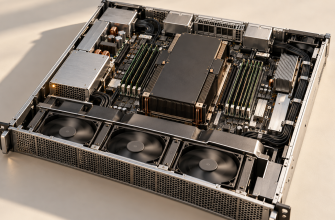
Electricity passes through multiple stages before reaching those transistors. Transformers, rectifiers, DC-DC converters and voltage-regulation circuits each serve different purposes.
The attraction of 800 VDC is to rethink where some of those conversion stages sit and how power travels between them.
The new path from the facility to the GPU
-
STAGE 01
Facility electrical supply
Grid-connected AC infrastructure supplies the data center. Protection, backup and transformation depend on facility design.
-
STAGE 02
800 VDC distribution
A suitable conversion system creates an 800-volt DC supply for distribution to compatible computing racks.
-
STAGE 03
Local voltage conversion
Rack and board power electronics reduce the voltage to levels required by servers, memory and processors.
Simplified functional path, not a wiring diagram. Actual designs include isolation, fault protection, monitoring, redundancy and additional conversion stages according to their architecture.
Increasing the distribution voltage can reduce the current carried over a particular part of this path.
It can also change where rectifiers and power supplies are installed. Instead of placing every large AC-to-DC conversion function inside or immediately beside computing equipment, certain architectures centralize conversion and deliver DC power to compatible racks.
This can free up space and potentially avoid conversion losses. The actual benefit depends on converter efficiency, cable lengths, redundancy and the operating load.
It is not a promise that converting AC into DC always saves energy. A poorly designed DC system could perform worse than a well-designed AC alternative.
Data centers will not replace every power system overnight
Most existing facilities have substantial investment in AC transformers, distribution, switchgear and protection equipment. Rebuilding all of it simply because a new generation of accelerators has arrived would be expensive and disruptive.
That is why the Open Compute Project’s work describes more than one deployment architecture.
| Architecture | Where conversion occurs | Main consideration |
|---|---|---|
| Conventional AC | AC is distributed to power equipment serving the computing racks. | Mature infrastructure with familiar designs, but high rack densities can increase conversion and distribution complexity. |
| Hybrid 800 VDC | A nearby side power rack converts existing AC supply into DC for compatible compute racks. | Offers a transition path without immediately replacing all upstream facility infrastructure. |
| Facility-scale 800 VDC | Conversion occurs farther upstream, with DC distributed through more of the data hall. | Potentially fewer conversion stages, but requires coordinated DC protection, distribution and facility design. |
Simplified architecture comparison based on the Open Compute Project’s published 2026 LVDC transition framework. Not every facility will follow the same design.
The near-term approach: convert power beside the servers
For an existing data center, a side power rack can receive an available AC supply and convert it to a DC distribution voltage required by compatible equipment.
The facility does not necessarily need to replace its entire upstream electrical system. It does, however, need adequate AC capacity, sufficient floor space, appropriate protection and certified equipment.
OCP describes this hybrid approach as an important transition path. Existing intermediate-voltage DC designs and newer native 800 VDC interfaces should not be assumed to be interchangeable.
The longer-term approach: change the data hall
A newly built facility has more freedom. Its designers can place high-capacity conversion systems farther upstream and distribute 800 VDC over a larger portion of the building.
OCP’s work includes transformer-rectifier and solid-state-transformer approaches for producing DC from medium-voltage AC supplies.
That architecture could also create useful integration points for energy storage and power smoothing. But backup capacity, conversion efficiency and fault behavior still have to be engineered and validated.
Higher voltage solves one problem and makes another harder
Carrying less current is attractive. Interrupting a fault in a high-voltage DC system is a different challenge.
AC current crosses zero repeatedly during each electrical cycle. That behavior can help interrupt an electrical arc when suitable switching equipment opens.
DC does not have the same natural periodic current zero crossing. A fault can therefore require carefully designed interruption and protection systems.
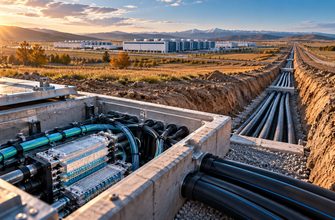
Higher-voltage conductors also need appropriate insulation, spacing, isolation, connectors, service procedures and protection against electric shock.
Less current to distribute
Raising voltage can reduce conductor current for a given amount of transmitted power. In a suitable design, that can make dense electrical distribution more practical and reduce selected losses or conversion equipment.
More demanding fault protection
Higher-voltage DC requires coordinated fault detection, isolation, switching, grounding arrangements and arc-flash assessment. Safe operation cannot be inferred from nominal voltage alone.
In July 2026, Schneider Electric published an analysis of DC arc-flash risks in two representative 800 VDC data center architectures: rack-level conversion and more centralized distribution.
The importance of that work is not that it demonstrates one universal risk level. It is that prospective DC architectures need their own fault analysis, taking account of converters, system configuration and protective devices.
In other words, switching to 800 VDC is not simply replacing copper with thinner copper. It changes part of the facility’s safety engineering.
800 volts cannot create electricity that the data center does not have
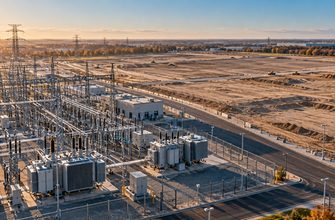
A higher distribution voltage can help move power through a building more efficiently. It does not increase the amount of electricity that the local grid can supply.
A data center waiting for utility capacity remains constrained even if its internal distribution system is exceptionally efficient.
This is the distinction behind our investigation into why AI servers can arrive before data centers have power for them.
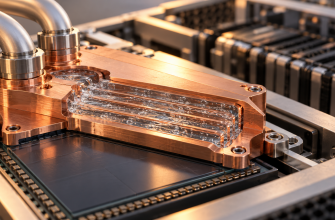
New distribution hardware also does not remove the heat generated by GPUs, CPUs, memory and other electronics. Our examination of a 135 kW AI rack’s cooling system follows that problem after electrical energy has entered the equipment.
Nor does changing voltage automatically eliminate rapid changes in electrical demand. Large synchronized workloads can create power fluctuations that require separate investigation and mitigation, as discussed in our report on AI workloads and grid oscillations.
These are connected engineering problems, but they are not the same problem.
What should engineers measure before calling 800 VDC more efficient?
A vendor can calculate the potential benefits of a power architecture. The harder question is what happens when the complete system is assembled, cooled and operated under realistic computing workloads.
A useful comparison should define the electrical boundaries and measure completed computing work alongside the electricity needed to support it.
Test the whole power path, not just the voltage
- Electrical input: Record real power at the chosen facility or distribution boundary. Use an equivalent boundary for every architecture being compared.
- Delivered output: Measure power after the relevant conversion and distribution stages. Account for both conversion losses and conductor losses.
- Operating load: Repeat measurements at low, typical and high utilization. A system’s efficiency may change with load.
- Thermal behavior: Record converter temperatures, cooling requirements and relevant auxiliary power.
- Dynamic behavior: Investigate voltage stability, transient demand, backup transitions and fault-response behavior using appropriate professional instruments.
- Useful output: Measure completed AI work and service quality, rather than assuming that an electrical efficiency gain automatically increases useful model throughput.
For example, a system that removes one conversion stage may save energy, but another stage might operate less efficiently under a particular load.
Similarly, reducing current in one conductor does not establish the efficiency of an entire facility. The conversion equipment, cable lengths, redundancy arrangements and cooling power still contribute to the total.
That is why proposed performance gains should be separated from independently measured results.
The next AI infrastructure challenge may be inside the power cabinet
In October 2026, the 800 VDC transition is becoming a coordinated industry effort rather than an isolated electrical experiment.
NVIDIA, Google and Microsoft are working through OCP on common requirements. Equipment suppliers are developing the converters, protection systems, connectors and distribution hardware needed to make those requirements useful.
The change is unlikely to happen everywhere at once. Existing facilities, hybrid upgrades and future purpose-built data centers have different requirements.
But the underlying reason is unlikely to disappear: more compute in a smaller space means more electrical power must pass through the same physical infrastructure.
The next generation of AI hardware will not be defined by GPUs alone. It will also depend on the conductors, converters and protection systems capable of keeping those GPUs supplied with electricity.
When a rack approaches the limits of its power delivery system, the next performance upgrade may start long before electricity reaches the processor.
Sources and reporting notes
- Open Compute Project — Powering the Next Era of AI . Industry alignment, transition architecture and safety requirements.
- NVIDIA — Why Scaling AI Compute Performance Requires a New Power Architecture . August 11, 2026. Vendor roadmap and deployment architecture.
- NVIDIA — OCP Global Summit: Vera Rubin Architecture and AI Factories . October 12, 2026. Industry developments and 800 VDC facility design announcement.
- Schneider Electric — DC Arc Flash Analysis: A Practical Study on 800 VDC AI Data Centers . July 31, 2026. Safety study based on modeled electrical architectures.
- Open Compute Project — Power Distribution . LVDC standardization scope and published white-paper resources.
Editorial methodology: the 100 kW current comparison is a first-principles calculation, not an equipment test. Manufacturer architecture descriptions are not independent performance measurements. No first-party 800 VDC hardware benchmark was performed for this article.