- The temperature that matters starts at the cold plate
- The same heat, a smaller temperature margin
- “Warmer water” needs a measurement location
- At the building, the trade can reverse
- A lower cooling bill can accompany a less efficient chip
- The warmest allowed setting is not automatically the best one
- Sources
Cooling water does not have to feel cold to remove heat from a processor. It has to be cool enough relative to the silicon, with a sufficiently effective path between them.
That is the attraction of warm-water cooling in an AI rack: raising the supply temperature can reduce the work needed to reject heat outdoors. The cost is less temperature headroom at the chip. Whether that trade is worthwhile depends on the rack, the cooling plant and the weather—not on a universal “warmer is better” rule.
The temperature that matters starts at the cold plate
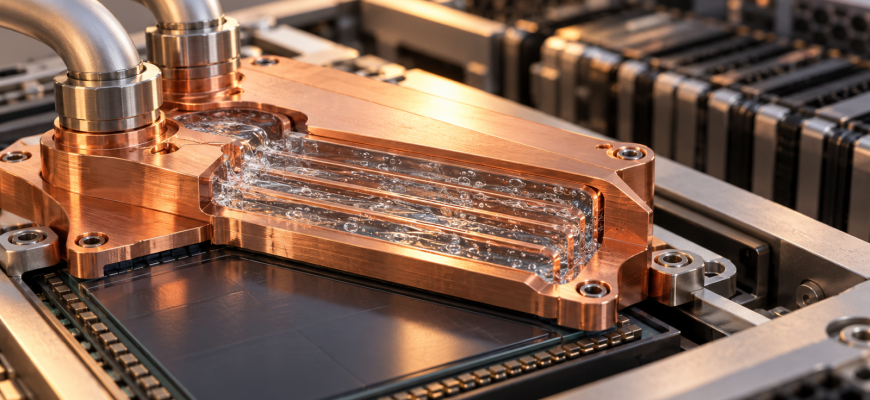
A cold plate is a metal heat exchanger mounted on a component. Heat crosses the chip package and thermal interfaces, reaches the plate and enters the flowing coolant. The chip must be hotter than the coolant for that heat to move out through a passive thermal path.
For a simplified steady-state estimate, write the relationship as chip temperature ≈ coolant inlet temperature + chip power × effective thermal resistance. The resistance summarises the difficulty of moving heat from the chip to that coolant reference. Package construction, mounting, cold-plate geometry and flow all influence it; it is not a universal GPU constant.
Hold power and that resistance fixed, and a warmer inlet shifts the estimated chip temperature upwards. Increasing flow or improving the plate might compensate, but those are additional changes, not benefits delivered by warmer water itself.
The same heat, a smaller temperature margin
An assumed 1,000 W chip, 0.035 K/W effective resistance and an illustrative 85°C ceiling.
Slate: inlet temperature · Cyan: rise to the chip · Dashed: remaining margin. Each bar ends at 85°C.
“Warmer water” needs a measurement location
A rack’s supply and return temperatures are different readings. Return coolant has already collected heat; a warm return does not establish that the inlet is equally warm. Nor is the liquid circulating through the chips necessarily the same water flowing through the building.
In a liquid-to-liquid cooling distribution unit, or CDU, a heat exchanger separates the technology loop serving the equipment from the facility loop. Vertiv describes the secondary loop’s isolation and control of temperature, pressure and flow. The separation also allows different fluid-quality requirements.
A real heat exchanger needs a temperature difference to move heat. Its capacity and operating conditions therefore matter when translating a facility-water setting into a rack-inlet temperature. A promise about “40°C water” is incomplete until the supplier identifies the loop and measurement point.
ASHRAE’s liquid-cooling class names embed upper facility-water temperature limits: W32, W40 and W45 correspond to 32°C, 40°C and 45°C. They describe environmental capability, not a command to run every installed rack at that temperature. The actual equipment specification remains decisive.
At the building, the trade can reverse
The cooling plant has a different job from the cold plate. It must move the collected heat into the environment. A higher permissible water temperature often makes that task easier because outdoor air can accept the heat under more weather conditions without as much mechanical refrigeration.
NVIDIA’s DSX facilities reference design illustrates the direction of travel: its 45°C cooling design point expands the operating window for heat rejection without full mechanical chilling. Dry coolers use fans to move outdoor air across heat-exchanger fins. This is a specific reference architecture, not proof that an existing rack can accept its setpoints.
“Free cooling” still requires equipment, electricity and suitable conditions. Pumps and fans continue working. During hot weather, the available temperature difference shrinks; the plant needs enough heat-rejection capacity or an appropriate backup cooling mode.
The US Department of Energy likewise explains how higher chilled-water temperatures can reduce chiller energy in compatible systems. The benefit is a system-level opportunity, not a fixed percentage saving for every degree added at a rack.
A lower cooling bill can accompany a less efficient chip
Chip temperature affects more than the distance to an emergency shutdown. Leakage power and frequency control can change before a hard thermal limit is reached. If the system reduces clocks to stay inside its thermal envelope, the job takes longer.
Microsoft researchers’ Open Compute Project paper on warm liquid-cooled facilities reports this tension. In its cold-plate experiments on an Intel Core i9-9900K, increasing inlet-water temperature reduced achievable performance under the tested conditions. That older desktop CPU experiment demonstrates a mechanism; it does not establish the performance curve of a modern AI accelerator.
A useful comparison consequently measures energy per completed workload at the whole facility, while checking throughput and response-time requirements. Lower compressor consumption is valuable, but it is not the entire account if the servers consume more energy per result or need longer to finish.
The warmest allowed setting is not automatically the best one
The practical operating point lies inside several limits at once: component temperatures, coolant chemistry, flow and pressure, the CDU’s performance and the outdoor plant’s capacity. Mixed racks add another constraint. Capturing most rack heat in liquid does not necessarily remove the air-cooling needs of every component.
There is also a lower boundary. Cold surfaces below the room’s dew point risk condensation; the CDU’s temperature control helps manage that problem. Simply choosing the coldest possible water is not a complete operating policy either.
Finally, circulation and consumption remain different quantities. Warm water in a closed equipment loop does not, by itself, tell you how much water the facility consumes. That depends heavily on how the collected heat leaves the site.
The sensible question is how warm the supply can be while preserving the required computing performance, operating margin and lowest overall cost of useful work. Answer it for the actual rack and climate, and the water temperature becomes a design decision rather than a slogan.
Sources
- Vertiv: Understanding CDUs — loop isolation, fluid control and condensation prevention.
- ASHRAE: AI Data Center Energy Performance Framework — water-temperature class definitions.
- NVIDIA: DSX facilities reference design — 45°C design point and outdoor heat rejection.
- US DOE: Cooling Water Efficiency Opportunities — cooling-plant energy and water relationships.
- Microsoft / OCP: Warm Liquid Cooled Cloud Facilities — experimental and package-level performance trade-offs.