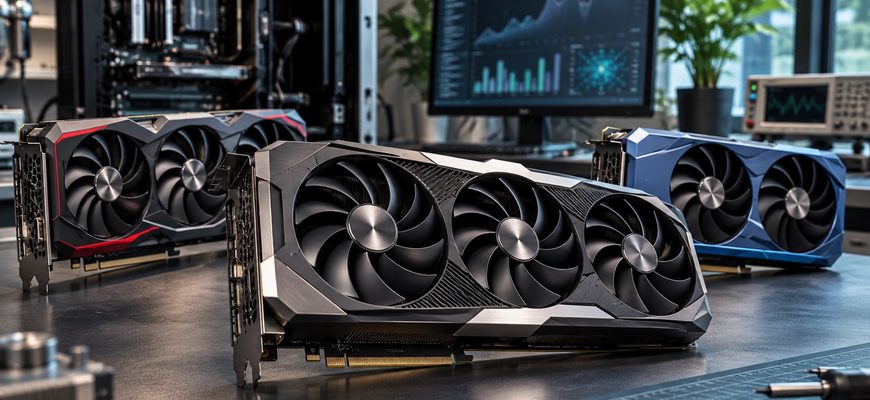
Find the right GPU for local LLMs, compare hardware, and estimate memory and running costs with six browser-based tools.
The best GPU for AI is not necessarily the fastest graphics card in a gaming chart. A local language model may fail on a high-end 16 GB device and run entirely on a slower 24 GB card. A diffusion pipeline can have the opposite preference: once both devices hold the complete workload, the quality of the available kernels and the rate at which the processor executes them can dominate the result.
Start by defining the workload: model size and format, concurrent requests, context, expected generation speed, and whether inference or training is the goal. Then establish a memory budget and choose a software stack. Only after those steps should you compare acquisition cost, board power, physical fit and expected operating costs.
If you are planning a complete machine, see our local AI hardware sizing guide.
Best GPUs for AI at a glance
| Use case | GPU to evaluate | Why consider it |
|---|---|---|
| Entry-level CUDA | RTX 3060 12 GB | More memory than many 8 GB cards. Inspect condition and price. |
| General-purpose AI | RTX 5060 Ti 16 GB | Useful capacity for smaller local models. |
| Used 24 GB CUDA | RTX 3090 24 GB | Capacity-first option. Check thermals, power and condition. |
| High-end consumer AI | RTX 5090 32 GB | Large consumer memory capacity, with demanding power and cooling requirements. |
| AMD alternative | RX 7900 XTX / AI PRO R9700 | 24–32 GB of memory if the exact software backend is supported. |
| Intel alternative | Arc B580 / Arc Pro B60 | Evaluate with an Intel-compatible inference engine. |
| Large workstation models | RTX PRO 6000 Blackwell 96 GB | Single-card capacity for larger quantized models. |
These are editorial starting points, not benchmark winners or verified price rankings. Compare actual quotes and software support before buying.
Find a GPU for your workload
AI GPU Finder
Screen candidate GPUs by your hardware requirements and preferred software ecosystem.
How much VRAM do you need for AI?
A model file is only one part of the allocation. Model weights are persistent; attention key/value data grows with the number of live tokens and sequences; temporary activations, allocator fragmentation, framework libraries and display usage consume additional memory.
For a dense model, raw weight bytes equal the parameter count multiplied by the bits per weight, divided by eight. An 8-billion-parameter model at four bits requires 4 GB, or approximately 3.73 GiB, before quantization metadata and runtime overhead.
For standard decoder attention, KV cache bytes equal:
The factor of two represents keys and values. For a model with 32 layers, eight KV heads, a head dimension of 128, FP16 cache and 8192 tokens, one sequence consumes 1 GiB of KV memory. Four concurrent sequences require 4 GiB under the same assumptions.
MLA, sliding-window attention, hybrid architectures and engine-specific cache optimizations may require different calculations.
Advanced LLM VRAM calculator
Estimate memory requirements for a dense decoder-only transformer.
In the 8B example, four-bit weights with 10% metadata, a 1 GiB cache, 1.5 GiB runtime overhead and a 0.5 GiB reserve require approximately 7.10 GiB. Increasing the context fourfold changes the cache from 1 to 4 GiB.
Two 24 GB cards do not automatically act like a single 48 GB device. The inference engine must support appropriate placement or model parallelism. Some buffers may be duplicated.
Further reading: context windows and VRAM, CPU offloading and 8 GB vs 12 GB vs 16 GB VRAM.
NVIDIA vs AMD vs Intel for AI
NVIDIA: CUDA
NVIDIA is a natural first candidate when the intended application depends on CUDA libraries or custom kernels. Architecture-specific optimizations and driver compatibility still matter. A PyTorch installation that recognizes a GPU is not proof that every downstream extension has a compatible binary.
AMD: ROCm and HIP
AMD is a serious option when the exact Radeon or Radeon PRO model, operating system and framework release are supported. Do not infer support from a nearby SKU or architecture name. Linux, native Windows and WSL support can differ. Consult the official Radeon compatibility matrices.
Intel: SYCL and OpenVINO
Intel Arc GPUs can be evaluated with oneAPI/SYCL, OpenVINO or other compatible engines. Verify the exact driver, supported operators and operating system. A cross-platform model file does not guarantee a cross-platform execution path.
The llama.cpp build documentation provides a practical starting point for investigating CUDA, HIP, Vulkan and SYCL backends.
Consumer vs professional GPUs
Professional GPUs are particularly valuable when memory capacity, ECC support, compact form factor, enterprise drivers or system-vendor support matter. A consumer GPU may be faster or cheaper for a task that fits inside its memory.
| Consideration | Consumer GPUs | Professional GPUs |
|---|---|---|
| Memory capacity | Usually lower | High-capacity workstation options |
| ECC | Often unavailable or unverified | Available on selected models |
| Physical design | Large multi-slot designs are common | Compact and specialized options |
| Acquisition cost | Often attractive for personal use | Depends on required workstation features |
ECC can reduce the risk of certain memory errors but does not guarantee correctness or availability. Passive-cooled cards require engineered chassis airflow. Compare actual board dimensions, PSU requirements and motherboard layout before purchasing.
Complete AI GPU database
Compare 65 desktop and workstation GPU configurations from NVIDIA, AMD and Intel. The specifications below are nominal manufacturer figures where available. They are not measured AI performance.
A dash means the value has not been verified. Current prices, retail availability and exact runtime compatibility require additional checks. Individual reviews will be linked as they are published.
Explore all 65 GPU configurations
65 configurations
| GPU | Category | Architecture | VRAM GB | Memory | GB/s | Bus bit | Power W | ECC | PCIe |
|---|---|---|---|---|---|---|---|---|---|
| NVIDIA GeForce RTX 5090 | Consumer | Blackwell | 32 | GDDR7 | 1792 | 512 | 575 | — | 5 |
| NVIDIA GeForce RTX 5080 | Consumer | Blackwell | 16 | GDDR7 | 960 | 256 | 360 | — | 5 |
| NVIDIA GeForce RTX 5070 Ti | Consumer | Blackwell | 16 | GDDR7 | 896 | 256 | 300 | — | 5 |
| NVIDIA GeForce RTX 5070 | Consumer | Blackwell | 12 | GDDR7 | 672 | 192 | 250 | — | 5 |
| NVIDIA GeForce RTX 5060 Ti | Consumer | Blackwell | 16 | GDDR7 | 448 | 128 | 180 | — | 5 |
| NVIDIA GeForce RTX 5060 Ti | Consumer | Blackwell | 8 | GDDR7 | 448 | 128 | 180 | — | 5 |
| NVIDIA GeForce RTX 5060 | Consumer | Blackwell | 8 | GDDR7 | 448 | 128 | 145 | — | 5 |
| NVIDIA GeForce RTX 5050 | Consumer | Blackwell | 8 | GDDR6 | 320 | 128 | 130 | — | 5 |
| NVIDIA GeForce RTX 4090 | Consumer | Ada Lovelace | 24 | GDDR6X | 1008 | 384 | 450 | — | 4 |
| NVIDIA GeForce RTX 4080 SUPER | Consumer | Ada Lovelace | 16 | GDDR6X | 736 | 256 | 320 | — | 4 |
| NVIDIA GeForce RTX 4070 Ti SUPER | Consumer | Ada Lovelace | 16 | GDDR6X | 672 | 256 | 285 | — | 4 |
| NVIDIA GeForce RTX 4070 SUPER | Consumer | Ada Lovelace | 12 | GDDR6X | 504 | 192 | 220 | — | 4 |
| NVIDIA GeForce RTX 4060 Ti | Consumer | Ada Lovelace | 16 | GDDR6 | 288 | 128 | 165 | — | 4 |
| NVIDIA GeForce RTX 4060 | Consumer | Ada Lovelace | 8 | GDDR6 | 272 | 128 | 115 | — | 4 |
| NVIDIA GeForce RTX 3090 | Consumer | Ampere | 24 | GDDR6X | 936 | 384 | 350 | — | 4 |
| NVIDIA GeForce RTX 3060 | Consumer | Ampere | 12 | GDDR6 | 360 | 192 | 170 | — | 4 |
| AMD Radeon RX 9070 XT | Consumer | RDNA 4 | 16 | GDDR6 | 640 | 256 | 304 | — | 5 |
| AMD Radeon RX 9070 | Consumer | RDNA 4 | 16 | GDDR6 | 640 | 256 | 220 | — | 5 |
| AMD Radeon RX 9070 GRE | Consumer | RDNA 4 | 12 | GDDR6 | 432 | 192 | 220 | — | 5 |
| AMD Radeon RX 9060 XT | Consumer | RDNA 4 | 16 | GDDR6 | 320 | 128 | 160 | — | 5 |
| AMD Radeon RX 9060 XT | Consumer | RDNA 4 | 8 | GDDR6 | 320 | 128 | 150 | — | 5 |
| AMD Radeon RX 9060 | Consumer | RDNA 4 | 8 | GDDR6 | 288 | 128 | 132 | — | 5 |
| AMD Radeon RX 9050 | Consumer | RDNA 4 | 8 | GDDR6 | 288 | 128 | 92 | — | 5 |
| AMD Radeon RX 7900 XTX | Consumer | RDNA 3 | 24 | GDDR6 | 960 | 384 | 355 | — | 4 |
| AMD Radeon RX 7900 XT | Consumer | RDNA 3 | 20 | GDDR6 | 800 | 320 | 315 | — | 4 |
| AMD Radeon RX 7800 XT | Consumer | RDNA 3 | 16 | GDDR6 | 624 | 256 | 263 | — | 4 |
| AMD Radeon RX 7600 XT | Consumer | RDNA 3 | 16 | GDDR6 | 288 | 128 | 190 | — | 4 |
| Intel Arc B580 | Consumer | Xe2 | 12 | GDDR6 | 456 | 192 | 190 | — | 4 |
| Intel Arc B570 | Consumer | Xe2 | 10 | GDDR6 | 380 | 160 | 150 | — | 4 |
| Intel Arc A770 | Consumer | Xe HPG | 16 | GDDR6 | 560 | 256 | 225 | — | 4 |
| NVIDIA RTX PRO 6000 Blackwell Workstation | Professional | Blackwell | 96 | GDDR7 | 1792 | 512 | 600 | Yes | 5 |
| NVIDIA RTX PRO 6000 Blackwell Max-Q | Professional | Blackwell | 96 | GDDR7 | 1792 | 512 | 300 | Yes | 5 |
| NVIDIA RTX PRO 5500 Blackwell | Professional | Blackwell | 84 | GDDR7 | 1398 | 448 | 600 | Yes | 5 |
| NVIDIA RTX PRO 5000 Blackwell | Professional | Blackwell | 72 | GDDR7 | 1344 | 384 | 300 | Yes | 5 |
| NVIDIA RTX PRO 5000 Blackwell | Professional | Blackwell | 48 | GDDR7 | 1344 | 384 | 300 | Yes | 5 |
| NVIDIA RTX PRO 4500 Blackwell | Professional | Blackwell | 32 | GDDR7 | 896 | 256 | 200 | Yes | 5 |
| NVIDIA RTX PRO 4000 Blackwell | Professional | Blackwell | 24 | GDDR7 | 672 | 192 | 145 | Yes | 5 |
| NVIDIA RTX PRO 4000 Blackwell SFF | Professional | Blackwell | 24 | GDDR7 | 432 | 192 | 70 | Yes | 5 |
| NVIDIA RTX PRO 2000 Blackwell | Professional | Blackwell | 16 | GDDR7 | 288 | 128 | 70 | Yes | 5 |
| NVIDIA RTX 6000 Ada | Professional | Ada Lovelace | 48 | GDDR6 | 960 | 384 | 300 | Yes | 4 |
| NVIDIA RTX 5000 Ada | Professional | Ada Lovelace | 32 | GDDR6 | 576 | 256 | 250 | Yes | 4 |
| NVIDIA RTX 4500 Ada | Professional | Ada Lovelace | 24 | GDDR6 | 432 | 192 | 210 | Yes | 4 |
| NVIDIA RTX 4000 Ada | Professional | Ada Lovelace | 20 | GDDR6 | 360 | 160 | 130 | Yes | 4 |
| NVIDIA RTX 4000 SFF Ada | Professional | Ada Lovelace | 20 | GDDR6 | 280 | 160 | 70 | Yes | 4 |
| NVIDIA RTX 2000 Ada | Professional | Ada Lovelace | 16 | GDDR6 | 224 | 128 | 70 | Yes | 4 |
| NVIDIA RTX A6000 | Professional | Ampere | 48 | GDDR6 | 768 | 384 | 300 | Yes | 4 |
| NVIDIA RTX A5500 | Professional | Ampere | 24 | GDDR6 | 768 | 384 | 230 | Yes | 4 |
| NVIDIA RTX A5000 | Professional | Ampere | 24 | GDDR6 | 768 | 384 | 230 | Yes | 4 |
| NVIDIA RTX A4500 | Professional | Ampere | 20 | GDDR6 | 640 | 320 | 200 | Yes | 4 |
| NVIDIA RTX A4000 | Professional | Ampere | 16 | GDDR6 | 448 | 256 | 140 | Yes | 4 |
| NVIDIA RTX A2000 | Professional | Ampere | 12 | GDDR6 | 288 | 192 | 70 | Yes | 4 |
| NVIDIA RTX A1000 | Professional | Ampere | 8 | GDDR6 | 192 | 128 | 50 | — | 4 |
| AMD Radeon AI PRO R9700S | Professional | RDNA 4 | 32 | GDDR6 | 640 | 256 | 300 | Linux only | 5 |
| AMD Radeon AI PRO R9700 | Professional | RDNA 4 | 32 | GDDR6 | 640 | 256 | 300 | Linux only | 5 |
| AMD Radeon AI PRO R9600D | Professional | RDNA 4 | 32 | GDDR6 | 640 | 256 | 150 | Linux only | 5 |
| AMD Radeon AI PRO R9600 | Professional | RDNA 4 | 32 | GDDR6 | 640 | 256 | 150 | Linux only | 5 |
| AMD Radeon PRO W7900 | Professional | RDNA 3 | 48 | GDDR6 | 864 | 384 | 295 | Yes | 4 |
| AMD Radeon PRO W7800 | Professional | RDNA 3 | 32 | GDDR6 | 576 | 256 | 260 | Yes | 4 |
| AMD Radeon PRO W7800 | Professional | RDNA 3 | 48 | GDDR6 | 864 | 384 | 260 | Yes | 4 |
| AMD Radeon PRO W7700 | Professional | RDNA 3 | 16 | GDDR6 | 576 | 256 | 190 | Yes | 4 |
| Intel Arc Pro B70 | Professional | Xe2 | 32 | GDDR6 | 608 | 256 | 230 | Yes | 5 |
| Intel Arc Pro B65 | Professional | Xe2 | 32 | GDDR6 | 608 | 256 | 200 | — | 5 |
| Intel Arc Pro B60 | Professional | Xe2 | 24 | GDDR6 | 456 | 192 | 200 | — | 5 |
| Intel Arc Pro B50 | Professional | Xe2 | 16 | GDDR6 | 224 | 128 | 70 | Yes | 5 |
| Intel Arc Pro A60 | Professional | Xe HPG | 12 | GDDR6 | 384 | 192 | 130 | — | 4 |
Compare AI GPUs side by side
AI GPU Comparison
Select two to four distinct GPUs. Compare memory capacity, bandwidth, board power, architecture and software ecosystem. No synthetic performance scores are used.
GPU power consumption and electricity costs
Power labels are useful for system design, but they cannot predict a monthly electricity bill without a workload model. Use a wall meter for the complete machine whenever possible. Component DC consumption must be adjusted for PSU efficiency once; measured wall consumption already includes this loss.
A workstation with a 250 W GPU under load, 20 W idle GPU consumption, 80 W of other components, six active hours, eighteen idle hours and 90% PSU efficiency would consume 4.2 kWh per day before additional cooling. At $0.20/kWh, that is $0.84 per day.
Open electricity cost calculator
GPU Electricity Cost Calculator
What does local AI inference really cost?
Local inference has a fixed capital cost and a variable energy cost. A request spends time in both prompt processing and output generation. Estimate serial request time as input tokens divided by measured prefill throughput, plus output tokens divided by measured decode throughput.
Low utilization increases cost per useful token even if energy per token remains unchanged. Comparing local inference with an API requires the same workload, comparable output quality and pricing for both input and output tokens.
Open AI inference cost calculator
AI Inference Cost Calculator
Default values are hypothetical scenarios, not measured GPU benchmarks.
GPU total cost of ownership
Compare complete systems over the intended ownership period. Upfront expenditure includes graphics cards and additional system hardware. Operating costs include electricity, cooling and maintenance. Resale value is credited at disposal rather than every year.
Estimate a base case and a high-energy case, then check a lower resale scenario. A business-critical deployment should also account for downtime and engineering labor.
Open total cost of ownership calculator
GPU Total Cost of Ownership
Final recommendations
Buy the card that meets the memory requirement with a defensible margin, works with the chosen software and fits the workstation. Compare at least one lower-cost candidate and one higher-capacity alternative. Request actual prices for the exact variant.
Profile the workload, including long prompts, peak concurrency and sustained thermals. If the model does not fit, choose between a smaller model, lower precision, reduced concurrency, supported offloading or a higher-capacity device. A faster GPU with the same amount of memory does not necessarily solve an allocation failure.
Where possible, borrow, rent or test a similar system before committing to a purchase. Use the GPU Finder and VRAM calculator to narrow the list, then compare specifications and quantify the operating assumptions.
Sources and technical documentation
Manufacturer specification catalogs and software documentation form the basis of this guide. Exact runtime support, current prices and comparable measured benchmarks remain subject to further verification.