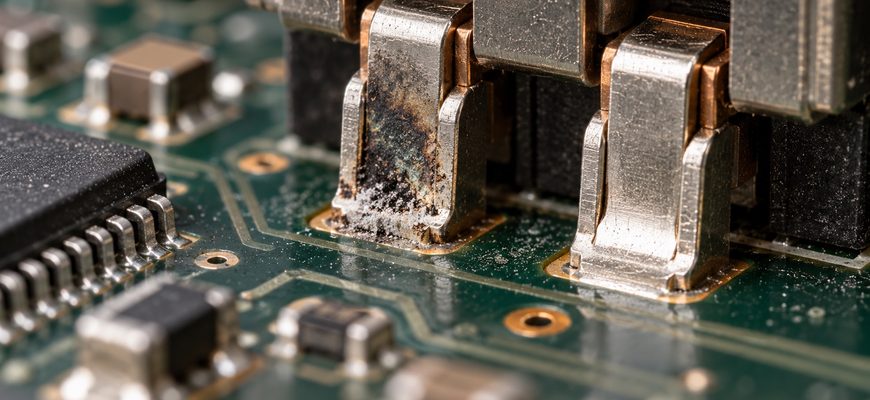
The installation manual for Dell’s PowerEdge XE9680L does not stop at temperature and humidity. It also specifies how quickly copper and silver test surfaces may corrode in the surrounding air.
That is a different kind of environmental limit. A server can remain cool while airborne contaminants attack its electrical connections. Deposited dust can also absorb moisture and create unwanted conducting paths without a visible water droplet.
The air’s temperature tells you about one operating condition. It does not tell you everything the air is delivering to the circuit board.
A thin film can matter before the board looks wet
Dust is not a single material. An ordinary deposit may be largely benign; another may contain salts that attract water. What matters electrically is its composition and behaviour on the surface, not simply whether a technician can see it.
IBM’s gas and particulate exposure guidance defines the deliquescent relative humidity of a contaminant: the humidity at which it absorbs enough water to become wet and promote ionic conduction.
This is different from bulk condensation on a cold object. A moisture-absorbing deposit can form a conductive liquid phase at a relative humidity below saturation. It does not require the room air to reach 100% relative humidity.
On a circuit board, an unwanted conducting path between features at different voltages can produce leakage current and contribute to electrochemical damage. Temperature monitoring may show nothing unusual while the surface condition changes.
The important change is on the surface
Two simplified circuit-board conditions. Neither requires the server to overheat.
Separate conductors rely on the intervening surface remaining sufficiently insulating.
A wetted ionic deposit can create a leakage path across that gap, even without visible condensation.
Some damage arrives as a gas
Particles are only part of the problem. Corrosive gases can react with exposed metals. Sulfur-bearing contamination is particularly relevant to copper and silver used in electronic assemblies.
ASHRAE’s 2011 contamination guidance describes two different failure mechanisms. Copper corrosion products can spread across a board and bridge closely spaced features. Attack on silver-containing component terminations can consume the conducting material and produce an open circuit.
These are documented mechanisms, not a prediction that every dusty server room will fail. The chemistry of the contaminants, the materials exposed and the environment determine the risk. ASHRAE’s published summary of research project RP-1755 examines that interaction between gaseous pollution, temperature and humidity. A thermal operating envelope alone does not describe the mixture of pollutants present.
The distinction also changes the diagnosis. Replacing a failed board may restore service while leaving the environmental cause in place for its replacement.
Why the manual measures air with metal coupons
A corrosion coupon is a prepared metal surface exposed to the environment for analysis. Copper and silver coupons provide evidence of the air’s effect on those materials over the exposure period, rather than merely reporting the concentration of one gas.
The XE9680L manual’s gaseous-contamination table specifies a copper-coupon corrosion rate below 300 angstroms per month and a silver-coupon rate below 200. Its note states that maximum corrosive-contaminant levels are measured at no more than 50% relative humidity.
For scale, one angstrom is 0.1 nanometres. Those thickness rates correspond to 30 and 20 nanometres per month. They describe corrosion-product growth on test surfaces—not a server’s remaining metal thickness or a countdown to failure.
These are the named model’s published requirements, not universal limits for every machine. They also are not airborne gas concentrations. Sampling position matters: IBM’s exposure guidance places reactive monitoring in the incoming rack airstream, illustrating why a convenient sensor elsewhere in the room may not represent the equipment’s exposure.
A particle filter does not answer the gas question
Dust collecting on filters is visible evidence that particles are being intercepted. It is not proof that corrosive gases have been removed. Filtration media must be selected for the contaminants they are intended to capture.
ASHRAE’s contamination guidance treats particulate filtration and gas-phase filtration as separate controls. It discusses cleaning incoming and recirculated air where gaseous contamination warrants it. The appropriate response therefore depends on what measurements identify, rather than simply installing a finer dust filter.
Outdoor-air cooling makes this boundary especially important: admitting favourable-temperature air also creates a path for whatever pollutants that air contains. That is a reason to assess intake air and filtration, not a blanket argument against economisers.
Contamination also has other physical consequences. A particle on an optical interface can impair transmission through a different mechanism, as in a dirty fibre connector in an AI cluster. The same word, “dust,” does not imply the same failure mode.
Liquid cooling does not make the remaining air irrelevant
Capturing processor heat in a liquid loop reduces one cooling burden. It does not establish that every component is sealed from the room. A high-density rack can still reject part of its heat to air, and equipment configurations differ in which electronics remain exposed.
Changing a coolant setpoint consequently cannot substitute for understanding a contamination problem. Neither does a humidity reading, considered alone, establish whether the deposited material stays dry or the metal surfaces remain chemically stable.
A useful investigation connects evidence at the rack inlet, deposited material and failed components. Temperature and humidity records show the operating environment; contamination sampling and reactive monitoring address different questions. Equipment documentation supplies the relevant acceptance criteria. None of those measurements should quietly stand in for all the others.
A normal temperature reading is valuable. It means the temperature at that sensor is normal. The hardware still has to survive the rest of the air.
Sources
- Dell: PowerEdge XE9680L contamination specifications — model-specific environmental requirements.
- IBM: Gas and Particulate Exposure Table — dust deliquescence and rack-inlet reactive monitoring.
- ASHRAE: 2011 Gaseous and Particulate Contamination Guidelines — corrosion mechanisms and filtration distinctions.
- ASHRAE: Published RP-1755 Research Summary — interactions between contaminants, temperature and humidity.