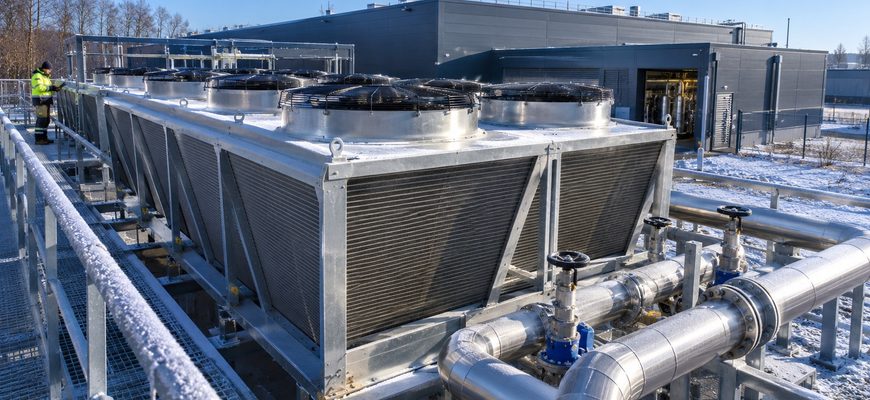
Winter does not make a data center stop producing heat. The servers still turn nearly all the electricity they consume into heat, and a cooling system still has to carry it away. What changes is the temperature of the place where that heat is finally rejected. On a cold day, the outdoor air can do more of that work without a compressor-driven chiller.
That is the principle behind data center free cooling, also called economizer cooling. The name is slightly misleading: air-moving fans, water pumps, controls and heat exchangers still use electricity. The major saving is the opportunity to reduce or bypass mechanical refrigeration for suitable hours, not an end to cooling.
The useful part of winter is the temperature difference
A cooling system transports heat from a warmer place to a cooler one. Inside a working server, silicon transfers heat into heatsinks, air or liquid cold plates. That heat then moves through air handlers, coolant loops or chillers before reaching the outdoors.
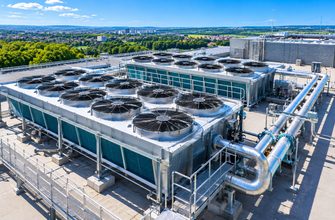
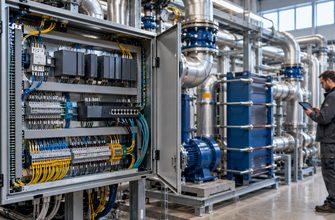
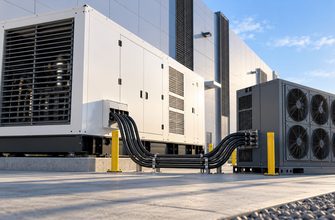
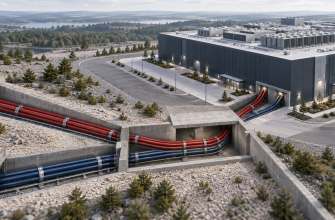
Mechanical refrigeration is valuable when the outdoor conditions cannot remove the required heat at the temperatures the servers and cooling plant need. In winter, the cooler heat sink makes alternative modes practical. A water-side economizer, for example, uses a heat exchanger and suitable outdoor heat rejection equipment to cool a building’s water loop while the mechanical chiller is reduced or bypassed. The US ENERGY STAR program describes this operating principle in its water-side economizer guidance.
A direct air-side economizer instead brings sufficiently clean, conditioned outdoor air into the data hall, displacing some or all of the usual mechanical cooling. An indirect air-side system transfers heat through an exchanger without mixing the two air streams. These are different designs; “opening the windows in winter” is not a description of either a properly engineered installation or its contamination controls.
Three different ways to take advantage of outdoor air
ASHRAE describes air-side, water-side and indirect economizer approaches in its data center and telecommunications facilities handbook. Choosing among them changes which equipment operates in winter and which constraints matter most.
| Mode | How heat gets outdoors | Still required |
|---|---|---|
| Direct air-side | Filtered and conditioned outdoor air replaces part or all of mechanically cooled supply air. | Air movement, filtration, humidity management and monitoring for airborne contamination. |
| Indirect air-side | Outdoor air cools a heat exchanger while indoor air remains separate. | Fans and exchanger pressure drop; sometimes supplemental refrigeration. |
| Water-side | Cool ambient conditions allow outdoor equipment and a heat exchanger to cool the facility loop. | Pumps, outdoor fans or cooling towers, freeze protection and reliable control valves. |
Energy STAR’s air-side economizer guidance explains why filtered outdoor air may be mixed with warmer return air during very cold periods. Simply supplying freezing air to electronics is neither necessary nor desirable; the goal is to deliver air within the equipment’s supported operating conditions.
Why colder is not automatically better
The advantage of a low outdoor temperature can disappear at the wrong boundary. A data hall may be cooled by a fluid loop that cannot safely approach freezing. Heat exchangers require a temperature difference of their own, so the facility supply temperature cannot simply equal the outdoor air temperature. Some systems need glycol, bypass valves or other freeze-protection measures that bring different trade-offs.
For air-side systems, outdoor air can be cold but too dry, too humid or contaminated for direct supply. The cost of filtering, humidifying or conditioning that air belongs in the total energy balance. ASHRAE explicitly notes filtration and corrosion concerns for direct air economizers in its AI data center thermal-efficiency framework.
There is also an important choice about cooling water temperature. IL.DIGITAL’s analysis of warmer coolant in an AI rack explains why raising the fluid temperature makes outdoor heat rejection easier, but can reduce thermal margin at the chip. Economizer performance cannot be optimized independently of the hardware that the loop serves.
This is an illustrative constant-load calculation, not a measured data center. It describes thermal energy the cooling system must transfer over a day. It does not mean the cooling plant consumes 24 MWh of electricity. The electrical energy used by the chillers, fans and pumps is a separate quantity, and changes by operating mode.
A winter day can still be a difficult cooling day
Outside temperature is only one variable in the control system. A facility may have exceptionally dense racks, restricted airflow, unusual humidity, maintenance on one chiller, or a cooling reserve that was designed for a different workload. Colder weather does not fix weak airflow management or a loss of circulation.
Consider the difference between a utility-scale seasonal strategy and a short-lived temperature spike inside one rack. The economizer may be working normally while a hot exhaust recirculation pocket drives one server above its inlet limits. Our article on how one hot server can disturb neighboring rack cooling explores that local problem. Free cooling changes the cost of rejecting heat outdoors; it does not change the need to move heat through every internal stage.
Thermal storage is another distinct tool. A tank of chilled water shifts when cooling energy is supplied; it is not the same as lowering chiller power because ambient conditions have improved. The site’s analysis of chilled-water storage explains how its usable reserve depends on water temperatures and system design.
What winter efficiency numbers actually require
To judge an economizer, engineers look at its hours of operation, outdoor wet-bulb or dry-bulb conditions as appropriate, supply temperatures, chiller power, fan and pump power and the thermal load. A savings estimate should specify whether it counts only the compressor, the cooling plant or the entire facility.
Annual energy reduction depends on climate and the installation. A claim that a system runs in free-cooling mode for many hours in one region cannot simply be applied to another location with different humidity, controls or heat loads. Likewise, a lower chiller energy meter does not necessarily reveal the energy added to an outdoor pump or fan.
Winter’s real advantage is a lower-cost path for the same heat. A data center that still rejects its normal thermal load while using fewer compressor hours has improved its cooling efficiency. It has not somehow made its servers stop creating heat.