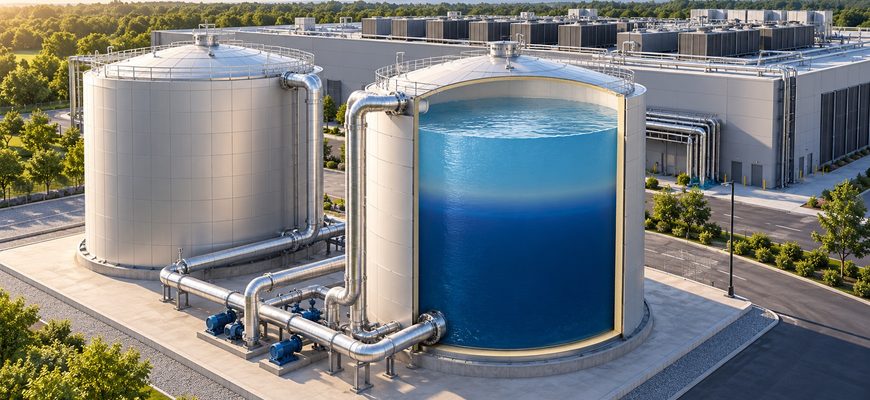
Two 20,000-gallon tanks appear in a 2017 specification for the Chesapeake ITCC data center. Their stated purpose: 15 minutes of cooling at the full design cooling load. On the same page, the chilled-water pumps and room-cooling fan motors are listed as having uninterruptible power supply protection.
Those details belong together. The tanks hold water cold enough to absorb heat while other cooling equipment is unavailable. The electrical backup keeps that reserve moving through the equipment that needs it. The figures are a historical design specification, not a universal runtime or a reported outage test.
That is one reason some data centers keep enormous tanks of chilled water. Others use storage to move cooling production away from expensive peak hours or to soften rapid load changes. In each case, the tank separates the moment cooling is produced from the moment it is needed.
A cooling reserve needs a working route to the servers
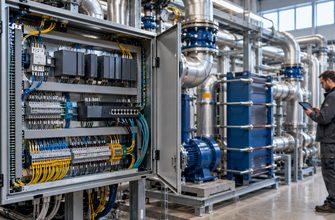
The Chesapeake specification is useful because it describes more than tank volume. It also lists heat exchangers and the protected pumps and fans. Its 15-minute figure applies to that documented configuration and load.
In an air-cooled room served by chilled-water units, fans move warm room air across a water-cooled coil. The water absorbs heat, and pumps carry it away. If a reserve tank supplies sufficiently cold water while the chiller plant recovers, that heat-transfer route can continue functioning.
A full tank cannot compensate for a stopped circulation pump, a closed valve or an unpowered fan on that route. Nor does it generate electricity for the IT equipment. Electrical continuity and cooling continuity are separate requirements.
A current manufacturer example makes the distinction between storage and cooling production explicit. Cimarron describes a thermal-storage vessel intended to provide approximately five minutes of cooling ride-through in its initial application after air coolers stop. That is the manufacturer’s application-specific design description, not a general promise for other sites.
The tank stays full while its useful reserve shrinks
In a stratified chilled-water tank, colder, denser water sits below warmer water. A transition layer called the thermocline separates them. Carefully designed inlet and outlet diffusers limit mixing, as described in ASHRAE’s thermal-storage chapter.
During discharge, cold water leaves near the bottom while warmer return water enters near the top. The warm region expands downward. Recharging reverses the process: cooled water enters below, and warmer water leaves above to be cooled again.
Same water level. Less cooling left.
Warmer return water → upper inlet
Lower outlet → cooling load
Warmer return water → upper inlet
Lower outlet → cooling load
The practical limit arrives when the delivered water no longer meets the system’s temperature requirement. Water level alone cannot show how much useful cooling remains.
Volume buys time, but temperature sets its value
Water absorbs heat as its temperature rises. For a given volume, a larger usable temperature difference stores more cooling capacity. “Usable” matters: the equipment and heat exchangers must still receive water at acceptable conditions.
This is the storage counterpart to the relationship between flow and temperature rise in a high-density AI rack’s cooling loop. In one case, engineers ask how quickly moving water carries heat away. In the other, they ask how much heat a reserve can absorb before its useful temperature range is exhausted.
At the same available cooling energy, doubling the supported heat load halves the ideal duration. Real delivery also depends on mixing, heat entering through the tank walls, flow limits and the state of charge when the interruption begins. A tank’s nameplate volume therefore does not establish a guaranteed number of safe minutes.
Sometimes the goal is a smaller afternoon electricity peak
Thermal storage also serves a daily operating purpose. A cooling plant charges the store when conditions are favorable, then draws on it when electricity demand or prices are higher. Servers continue producing heat throughout; some of the work of preparing their cooling supply has moved to another time.
The US Department of Energy’s 2024 data-center design guide identifies peak electrical demand savings and improved chilled-water reliability as potential benefits. Where suitable nighttime conditions allow, an economizer can help charge storage using outdoor cooling conditions rather than relying entirely on compressor operation.
Lower peak demand does not automatically mean lower total electricity use. Charging, circulating and storing water introduce their own losses and operating requirements. DOE’s water-efficiency guidance also cautions that thermal storage need not produce significant energy or water savings. The result depends on the complete plant and its operating conditions.
There is a control trade-off if one store serves both daily load shifting and emergency reserve. Cooling spent reducing an afternoon peak is unavailable for an interruption unless the operating policy preserves enough reserve. The relevant quantity is the usable inventory at that moment, not the tank’s maximum capacity.
Where the tank connects changes what it does
A tank that steadies water returning to chillers is doing a different job from a store arranged to maintain supply when the plant is down. Trane’s 250 MW AI factory reference design distinguishes supply-side storage for plant interruptions from return-side storage that smooths temperature swings. This is design guidance, not evidence that every AI facility uses that arrangement.
The stored water also need not be the liquid flowing through a processor’s cold plate. Heat exchangers can separate the facility water from the equipment-side coolant. Storage protects only the heat path it is connected and controlled to support.
Nor should a chilled-water thermal store be confused with a tank of replacement water for cooling-tower losses. One holds a temperature reserve; the other holds water needed to replenish a system. A large cylinder outside a data center does not reveal its purpose without the piping and operating description.
The useful question is therefore how much cooling the tank can still deliver, at the required temperature and flow, while the rest of the plant changes state. A giant reservoir earns its space by making that transition manageable.
Sources
- Chesapeake Central Plant/Data Center Specifications, 2017 document hosted by ASHRAE Central Oklahoma
- ASHRAE Handbook, 2020: Thermal Storage
- Cimarron: Thermal Energy Storage Tanks for Data Center Cooling
- US Department of Energy: Best Practices Guide for Energy-Efficient Data Center Design, revised July 2024
- US Department of Energy: Cooling Water Efficiency Opportunities for Federal Data Centers
- Trane: 250 MW AI Factory Reference Design, thermal-storage guidance