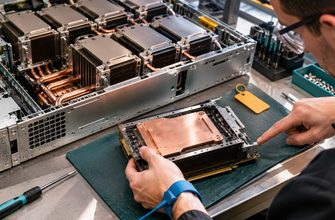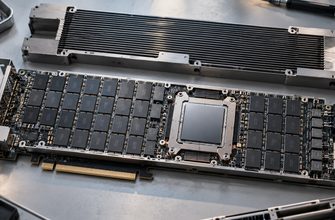
HPE lists a fully loaded GB200 NVL72 AI rack at approximately 3,245 lb, or 1,472 kg. That is almost a tonne and a half before anyone asks whether the room has enough electricity to switch it on. The figure comes from the manufacturer’s published rack specification, not a weight measured by IL.DIGITAL.
A rack like this can exceed what a particular floor installation is designed to support. The answer depends on where its weight enters the floor, how that floor transfers the load into the building, and how the rack gets to its final position. A generous room-wide load allowance does not settle those questions.
For a team upgrading an existing server room, the surprise is that a stronger cabinet solves only one part of the problem. The rack frame, the floor panels and the building beneath them each have their own limits.
The weight arrives through a few small contact points
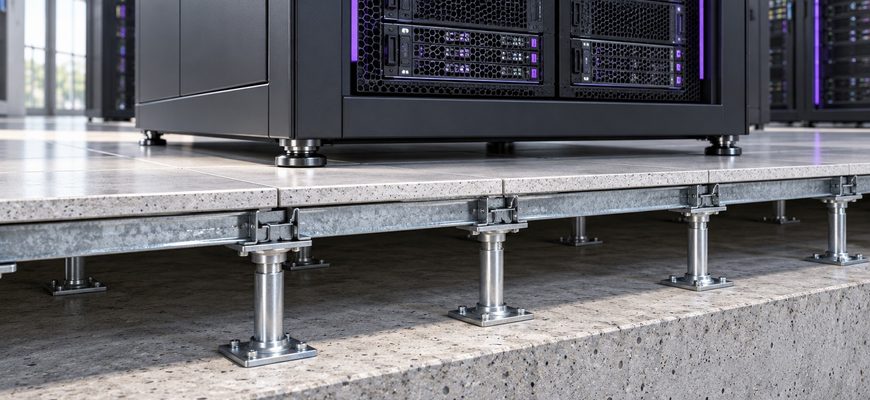
A rack occupies a rectangle on a floor plan. It usually transfers its weight through a small number of leveling feet or casters. The floor therefore receives concentrated forces at those contacts, rather than a perfectly even load across the cabinet’s footprint.
On a raised access floor, removable panels sit above the structural slab on a supporting framework. The panels, horizontal supports called stringers, and vertical pedestals must carry those forces. The slab underneath must then support the resulting loads along with the rest of the installation.
Feet or casters
Small contacts introduce concentrated loads.
Raised-floor panels
Panel strength and contact location matter.
Supporting framework
Stringers and pedestals carry load to the slab.
Structural slab
The building must support the complete layout.
ASHRAE’s 2023 data-center design guidance discusses supplemental pedestals for unusually heavy equipment, while explicitly requiring sufficient slab strength for both total and point loads. Adding support under a panel does not increase the building’s structural capacity.
A room without a raised floor removes the panel-and-pedestal layer. It still needs an assessment of the slab and the concentrated loads applied to it.
One rack produces several different load numbers
Consider an illustrative rack with an installed mass of 1,500 kg and a footprint measuring 0.8 by 1.2 m. Assume four feet share the load equally, each with a flat contact area of 0.1 by 0.1 m. These are chosen assumptions for explaining the arithmetic, not dimensions or support details specified for the HPE rack.
The contact pressure is about 24 times the footprint average in this example. That does not mean the building experiences 24 times the total weight. It means the same force first enters through much smaller areas.
Nor can contact pressure alone predict whether a raised-floor panel is adequate. Panel bending depends on its construction, supports and the positions of the feet. A contact near the middle of a panel creates a different loading condition from one near a support.
Real feet also need not carry equal shares. Equipment placement, the rack’s center of gravity and leveling affect the reactions. Actual support geometry and manufacturer load data belong in the assessment; dividing the mass by four is only the assumption used above.
A room-wide average introduces another scale. Dividing the mass of every rack by the area of the entire room includes empty aisles. That calculation does not demonstrate that an individual panel, support or part of the structural slab can carry the proposed arrangement.
The cabinet’s rating stops at the cabinet
In June 2026, Vertiv announced its Rack Extreme platform with manufacturer-stated static and dynamic load ratings up to 4,500 lb (about two tonnes). Those are cabinet ratings. They do not certify the floor under a loaded cabinet, or the route used to move it.
The weight budget also includes more than GPUs. NVIDIA’s GB rack hardware guide describes compute trays, NVLink switch trays, power shelves, a busbar, a copper interconnect backplane and liquid-cooling manifolds. The complete assembly determines the load.
Use the configured installation mass, with the vendor’s stated inclusions. Account for coolant and accessories where applicable, and keep shipping or packaged weights separate from operating weights. A nearby coolant distribution unit is another piece of floor-supported equipment with its own position and load.
Solving the rack’s cooling requirements therefore does not complete the physical installation review. Cooling capacity and structural capacity answer different questions about the same machine.
The difficult floor may be outside the server room
A fully assembled rack must pass through the building before it reaches its approved location. Loading areas, ramps, corridors and freight elevators all become part of the installation. The moving load includes any handling equipment used to carry it.
NVIDIA’s DGX H100-generation facility guide explicitly requires checking the complete path from loading dock to rack position for equipment weight plus the means used to transport it. This planning principle applies beyond that generation; its numerical rack estimates should not be substituted for a current configuration’s mass.
Rolling and stationary conditions require separate checks. ASHRAE notes that rolling-load tests use specified wheel sizes and numbers of passes, and that results are not always directly comparable. A static rating alone does not establish suitability for a heavy cabinet moving on small wheels.
The practical result might be an approved load-spreading arrangement, a different route or staged installation of components. The choice depends on the rack’s handling instructions and the building assessment. A sheet placed over weak panels cannot be assumed to make the whole route adequate.
A floor plan needs a weight map
Before approving a dense AI deployment, put the configured masses and actual support positions onto the proposed layout. Include adjacent equipment and the delivery route. The facilities team and structural engineer can then assess the complete load path against the installed floor system and building drawings.
There are several possible outcomes: the proposed installation is suitable, the layout needs to change, local supports need modification, or the structure needs reinforcement. Spacing out cabinets changes the distribution across the building; it does not reduce the force under each remaining cabinet’s feet. A load-spreading base can address a local condition only when its design and the supporting structure are verified.
As with AI servers waiting for usable electrical capacity, hardware delivery and deployment readiness are separate milestones. Here, the constraint remains even with the power disconnected: an idle rack weighs essentially the same as a busy one. Reducing GPU power will not make an overweight installation fit the floor’s limits.
Sources
- HPE: NVIDIA GB200 NVL72 QuickSpecs, including the approximate fully loaded weight.
- ASHRAE: 2023 Handbook, Data Centers and Telecommunication Facilities, raised-floor structure and rolling loads.
- NVIDIA: DGX GB rack hardware and DGX H100 facility planning: static weight and point load.
- Vertiv: Rack Extreme announcement, 9 June 2026.