Electricity can be available in a region without being deliverable to a new AI campus on the date its servers are ready. A large connection may need additional network capacity, electrical equipment and approvals before it can carry the requested load.
That timing problem is one reason some developers are arranging gas-fired power plants alongside their data centers. On-site generation offers another route to usable power, sometimes as a bridge to a larger grid connection and sometimes as part of a longer-term supply plan.
But a gas plant beside a data hall does not automatically mean the site has abandoned the grid. It may be backup capacity. And “their own plant” can mean dedicated generation supplied by an energy partner rather than a power station legally owned and operated by the AI company.
The missing ingredient is a firm delivery date
The International Energy Agency’s 2026 review of data-center power integration identifies constrained network capacity, long connection queues and slow permitting as important obstacles. It also notes a large number of announced on-site generation projects, particularly natural gas in the United States.
For a developer, the decision involves the schedule of the whole campus. Buildings, cooling equipment and GPU systems are useful only when the electrical supply is ready. The difference between receiving AI servers and being able to power them can determine when a facility starts serving customers.
A dedicated plant gives the project team more control over some parts of that schedule. It also moves work onto a different set of dependencies: fuel delivery, generating equipment, site construction and commissioning. It is an alternative infrastructure project, not a way to avoid infrastructure.
Two gas plants can have very different jobs
In an August 2025 description of its Abilene campus, Crusoe said the facility connects to the ERCOT grid and described installed GE Vernova gas turbines intended ultimately to provide backup power for its data halls. That is different from saying the campus normally runs entirely on its own gas plant.
GE Vernova’s Crusoe case study describes a package of 29 LM2500XPRESS turbines with nearly 1 GW of combined capability. Its deployment timetable is a manufacturer’s stated expectation, not an independent confirmation that every unit is operating. The example demonstrates the scale of dedicated generation being procured.
A separate proposal shows the bridge concept. On July 20, 2026, the US Department of Energy’s National Nuclear Security Administration selected Amentum for lease negotiations at the Savannah River Site. The proposed project pairs a 1 GW data center with approximately 2 GW of on-site generation, described as natural gas bridging to nuclear energy.
The same announcement explicitly says selection for negotiations is not a final lease award and that approvals remain necessary. It is evidence of a proposed supply strategy, not a commissioned gas-to-nuclear campus.
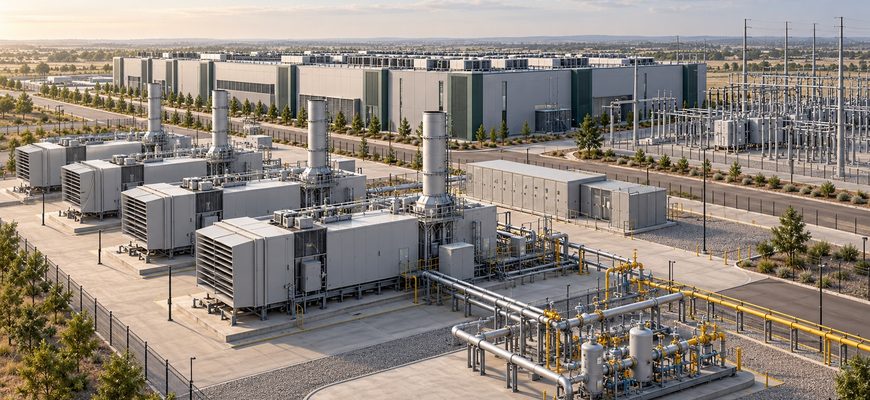
These distinctions matter when reading a headline. Backup generation, temporary primary supply and a long-term dedicated plant can look similar in an aerial photograph while operating under very different schedules.
The gas pipe becomes part of the power chain
A gas turbine burns fuel to drive a generator; gas-engine plants use reciprocating engines instead. The resulting electricity still has to pass through the facility’s electrical distribution and protection systems before it reaches the computing equipment.
Locating generation near the load can reduce dependence on a particular electricity-delivery bottleneck. It does not remove dependence on energy delivery. The plant now needs adequate gas supply and pressure, functioning fuel equipment and enough generating capacity available during maintenance or a unit failure.
On-site generation adds a supply route
Protected IT power paths · cooling equipment · other facility loads
The Department of Energy’s microgrid explanation describes locally coordinated generation and controls near large loads. That coordination matters: having generating machinery on the property does not by itself prove that the campus can disconnect from the grid and continue operating independently.
Nor is a plant’s nameplate rating the same as power continuously available to GPUs. The design must allow for plant auxiliaries, facility cooling, operating conditions and equipment outages. The servers’ heat-removal requirements continue regardless of where their electricity was generated.
Gas equipment has a queue too
Modular generating packages can make some projects easier to stage. GE Vernova describes its LM2500XPRESS packages as largely factory assembled. That can simplify installation, but installing a package is only one part of bringing a complete power station into service.
Equipment availability can become its own bottleneck. In results published on July 22, 2026, GE Vernova reported 116 GW of Gas Power equipment backlog and slot reservation agreements. That is a historical company-reported figure, not a delivery estimate for a particular data center.
A reservation, an equipment order and a commissioned plant are different milestones. A credible energization schedule needs the fuel connection, equipment deliveries, electrical works, operating approvals and tested controls to converge.
Running hours change the environmental comparison
A backup plant that runs occasionally and a plant supplying daily electricity should not be assessed as if they had the same duty. Emissions depend on fuel use over time, plant efficiency and the generation it replaces.
Burning natural gas produces carbon dioxide. The fuel supply chain adds emissions of its own, including methane. The IEA’s 2026 assessment of gas-supply emissions distinguishes upstream production and transport from combustion and explains that supply-chain emissions vary substantially. An individual plant’s footprint needs its actual fuel route and operating data.
Pollutant controls also answer a different question from carbon reduction. GE Vernova describes selective catalytic reduction for its Crusoe turbine packages, a technology targeting nitrogen oxides. That does not make gas combustion carbon-free.
A fair comparison therefore starts with the actual alternative: which electricity would serve the same load, when it would become available and how the plant would operate alongside it. The presence of a gas turbine alone cannot settle that comparison.
A bridge needs an exit plan
If gas generation is described as temporary, the transition should have a defined destination. A future grid connection or another generating technology needs its own capacity, schedule and approvals. Calling something a bridge does not establish when the bridge will stop being used.
For some AI projects, dedicated gas generation offers a way to bring computing capacity online sooner or strengthen a backup arrangement. Its value depends on whether the fuel, machinery and operating systems can deliver dependable power on the required date.
The decisive question is how much power the campus can reliably use, starting when, and with what continuing obligations. Building beside a gas plant changes the answer’s dependencies; it does not make them disappear.
Sources
- IEA: Powering Artificial Intelligence, 2026 executive summary
- Crusoe: An inside look at the Abilene AI data center, August 5, 2025
- GE Vernova: Crusoe LM2500XPRESS case study
- DOE/NNSA: Savannah River Site project selection for negotiations, July 20, 2026
- DOE: Energy Additions and the Unique Role of Microgrids, June 3, 2026
- GE Vernova: Second-quarter 2026 financial results
- IEA: Assessing emissions from LNG supply and abatement options, September 2026