- The inverter was already doing the work
- The input source changes. The inverter keeps supplying the load.
- Starting the engine is not the same as accepting its power
- Thirty seconds at one megawatt
- The handover has to survive the load arriving
- The protected load is smaller than “the whole building”
- The successful outage is the one the application barely notices
- Sources
A data center does not wait for a diesel engine to reach operating speed before it can keep supplying its servers. The immediate bridge is an uninterruptible power supply, or UPS, using stored energy.
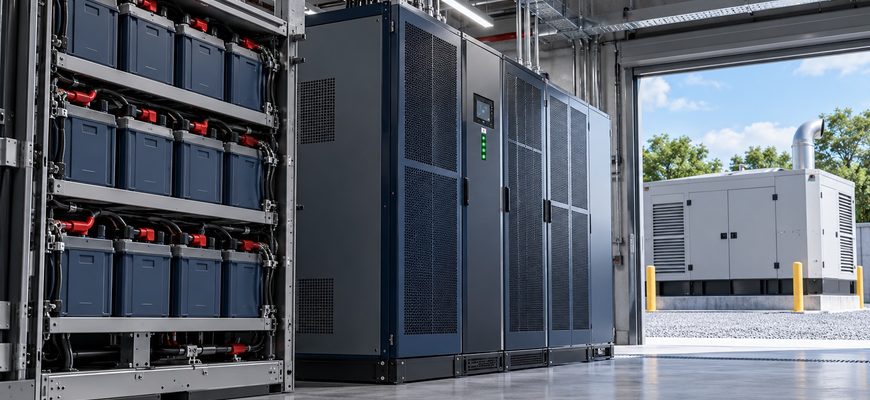
In a common online double-conversion design, the inverter supplying the protected equipment is already running before the outage. When the incoming supply disappears, the battery supports the UPS’s internal DC power link. The generator gets time to start without making the servers wait for it.
The critical handover is complete when usable generator power reaches the load through the electrical system. An engine that has merely started is only partway there.
The inverter was already doing the work
Incoming utility electricity is alternating current, or AC. In double-conversion operation, a rectifier converts it to direct current, DC. An inverter then produces the AC output used by the protected load.
The battery supplies that internal DC link during an input interruption. The inverter can continue producing output instead of waiting for a separate backup AC source to start.
Eaton’s explanation of UPS topologies describes this as zero transfer time to battery in online double-conversion operation. That description concerns the UPS output; it does not mean the generator starts instantly.
This article follows a healthy battery-backed UPS operating in that mode within its ratings. Standby, line-interactive, bypass and other operating arrangements have different behavior.
The input source changes. The inverter keeps supplying the load.
Shared downstream path
DC link → inverter → protected IT load
Starting the engine is not the same as accepting its power
The backup system has to recognize an unacceptable utility supply, issue a start command, bring the generator into operation and connect an acceptable alternative source.
The transfer equipment performs a different job from the UPS. It selects the upstream supply; the UPS bridges the interruption seen at its input. Cummins’ transfer-switch application manual explains source sensing and voltage and frequency acceptance conditions.
For an open-transition transfer, the old source is disconnected before the alternative is connected. A functioning UPS can cover that upstream break for its protected load. Larger installations may use more elaborate switchgear and generator arrangements, so one small transfer-switch diagram should not be mistaken for every facility’s design.
There is no single startup time that describes all of these systems. Detection settings, generator behavior, transfer conditions and loading sequence determine how long stored energy is needed.
Thirty seconds at one megawatt
The gap is short, but the power demand can be substantial. Consider an idealized calculation for a constant protected AC load of 1 megawatt sustained for 30 seconds:
1,000 kW × (30 ÷ 3,600) hours = 8.33 kWh delivered to the load.
This is energy arithmetic, not a battery-sizing recommendation or a claim about a particular site’s startup time. It excludes conversion losses, reserve and the effects of the actual battery discharge conditions.
The distinction between power and energy matters. A system must deliver the required rate of power throughout the interval, not merely contain enough nominal kilowatt-hours. A battery with a suitable energy label is not automatically capable of supporting a megawatt-scale UPS load.
If the same constant load had to be supported twice as long, the ideal delivered energy would double. Real selection requires the UPS and battery manufacturers’ discharge data for the intended operating conditions.
The handover has to survive the load arriving
A generator that looks stable before connection still has to accept the electrical demand. Applying a large load changes its operating conditions.
Eaton’s generator–UPS compatibility guidance explains why UPS topology, generator characteristics and sizing must be considered together. Having a generator and having a UPS are not, by themselves, proof that the pair will operate correctly.
One tool is controlled load acceptance. Caterpillar’s backup-power design guidance discusses staged loading and UPS “walk-in,” which gradually shifts demand from battery to generator.
That makes the useful endpoint more precise: the generator is carrying the intended load, the UPS has accepted the input and the protected equipment continues operating. A start signal or an engine-running indication alone does not establish that result.
The protected load is smaller than “the whole building”
UPS protection follows electrical connections. A server, network switch or control system benefits only if its supply is included in the protected arrangement. The presence of UPS cabinets does not establish protection for every device in the facility.
Cooling deserves particular attention. Pumps, fans and chillers have their own supply paths and recovery requirements. Keeping processors powered preserves their ability to work, but also preserves the heat they produce. The route followed by heat leaving a high-density AI rack still has to function.
This is part of the wider distinction between installed hardware and usable data-center capacity. The complete facility must support the workload, including during a change of power source.
The successful outage is the one the application barely notices
From the application’s perspective, a successful transfer leaves little to report. The server receives acceptable power throughout; its processes continue while upstream equipment changes source.
For the facility, that quiet outcome depends on several distinct jobs being completed: stored energy bridges the interruption, control equipment recognizes a usable source, and the generator accepts the load.
The battery supplies time for the transition. The meaningful proof is continuous operation through the complete handover, under the conditions the facility is designed to support.