- Follow the heat, not the cold air
- Why engineers choose the roof
- Outdoor airflow is close at hand
- It keeps the ground level available
- Heat rejection can be kept away from IT spaces
- Roof equipment is not necessarily a chiller
- The constraints hidden from an aerial photograph
- What changes when AI racks use warm-water cooling?
- Sources and further reading
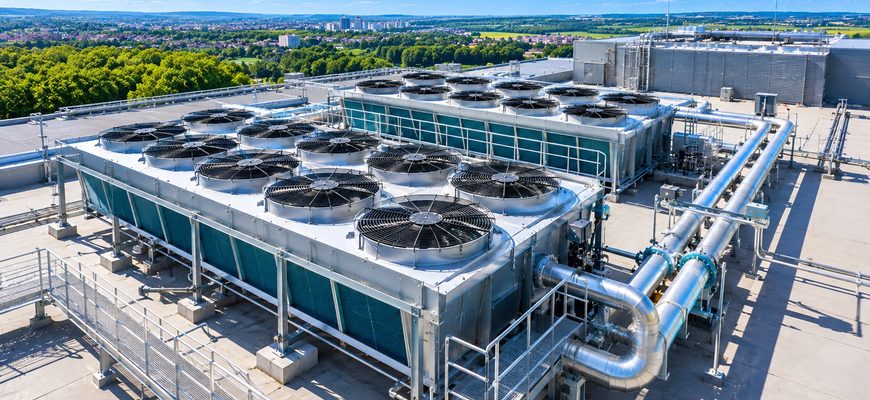
Look up at some data centers and you will find rows of giant fans, pipework and mechanical equipment on the roof. They are not there to blow cold air directly onto servers. Often, they are the final stage of a heat-removal system that carries warmth from the computer rooms to the outdoors.
Putting equipment on a roof can save ground-level space, simplify access to outdoor air and position the heat-rejection machinery away from occupied rooms. But a roof also introduces structural, weather, acoustic and maintenance challenges. There is no single layout that every data center should copy.
Follow the heat, not the cold air
Computers convert most of their electrical input into heat. Fans, liquid loops, heat exchangers and refrigeration equipment may move that heat through several stages before it reaches the outside. The rooftop equipment is often one of the last links in the chain.
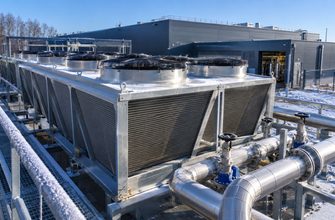
A dry cooler uses fans to move outdoor air across a heat exchanger carrying a circulating fluid. An air-cooled chiller rejects heat to outdoor air through its condenser. A cooling tower rejects heat through evaporative processes; its water and plume behavior differ from those of a dry cooler. These devices may look similar from a distance but they operate differently.
Why engineers choose the roof
Outdoor airflow is close at hand
Heat-rejection equipment needs a reliable flow of outside air. Roofs can provide fewer obstacles than a narrow enclosed courtyard. Placement still matters: hot exhaust must not flow immediately back into an intake, and nearby structures can alter airflow.
It keeps the ground level available
Large sites compete for yard space with loading access, generators, electrical substations, fuel systems and service routes. A roof can free some of that valuable area. On other campuses, dedicated ground-level cooling yards are simpler and better supported.
Heat rejection can be kept away from IT spaces
Mechanical fans, water handling and condenser equipment can be physically separated from the data halls. That does not eliminate risk: a leak, roof penetration, blocked drain or failed rooftop unit can still affect the building below. Engineers plan containment, access and inspection accordingly.
Roof equipment is not necessarily a chiller
A data center may use a dry cooler that relies largely on outdoor air to cool circulating liquid when temperatures permit. Another may use an air-cooled chiller requiring compressor work in warm weather. A cooling tower rejects heat using evaporation and consumes water, subject to water treatment and drift controls.
ASHRAE’s AI data-center energy guidance discusses economizers, closed-loop dry coolers and different climate-dependent heat-rejection strategies. The equipment choice depends partly on the temperature of the cooling fluid returning from the racks.
The constraints hidden from an aerial photograph
Weight and structure. Cooling equipment has operating loads, lifting needs and vibration characteristics. A roof must support the machinery, associated fluids and access safely; reinforcing it can be expensive, especially in an existing building.
Noise. Dense fans and compressors can be audible far beyond the roofline. Local planning rules, neighbors and nighttime operating limits shape equipment selection and sound attenuation.
Weather and service. Ice, snow, wind, airborne contaminants and summer heat affect performance and maintenance access. Rooftop machinery needs safe walkways, lifting plans and weather-resistant components.
Airflow and recirculation. Positioning fans too close to parapets, exhausts or one another can reduce performance. Rooftop space is not automatically better ventilated just because it is elevated.
Water and plume. Wet cooling towers need water quality management and can produce visible vapor plumes in suitable conditions. Dry coolers generally avoid the same evaporative water consumption but often require a different footprint and fan-power trade-off.
What changes when AI racks use warm-water cooling?
Liquid-cooled high-density equipment can reject heat through warmer fluid than some traditional chilled-water installations. When the outdoor air is cooler than the required fluid temperature by a sufficient margin, dry coolers may be able to do more of the work without mechanical refrigeration.
That is one reason modern AI cooling design is moving toward higher-temperature liquid loops. The benefit depends on climate, heat exchanger sizing, allowable equipment temperatures and the actual operating point. IL.DIGITAL examined those trade-offs in What Warmer Cooling Water Actually Does to an AI Rack.
Our report on how one failed server fan can slow AI hardware covers a different part of the cooling chain: local airflow close to the processors. Rooftop heat rejection cannot compensate for every problem inside a rack.
So why the roof? Because it may be the best place to meet the outside air, not because it is inherently colder or more efficient. The engineering answer is a balance of airflow, structure, water use, climate, cost and resilience—far more than the view from above suggests.