- First, the burger that actually faced a taste test
- So what does the computer actually do in the kitchen?
- Food companies are already using this idea
- Now for the really strange-looking possibility: printing dinner
- Why the layers matter more than the printer
- Could you eat some of this today? Yes. Here is what it costs.
- Can AI predict whether you will like it?
- What dinner might look like in ten years
- Sources and image credits
A computer designed a burger. Then 101 people sat down to eat it. In a 2026 experiment, some recipes generated by artificial intelligence performed as well as—or slightly better than—a familiar fast-food benchmark in a blind taste test. But when the researchers asked their model to favor nutrition above everything else, the resulting burger was considerably less popular. There is a lesson here for the future of food: the machine can explore recipes at enormous speed, but a human mouth still gets the final vote.
AI-designed food is already a practical part of commercial product development, from plant-based milk to cheese alternatives. And other technologies are making food look surprisingly different: edible ingredients can be printed in layers, while animal cells can be cultivated into seafood. These advances are often grouped together, yet they solve different problems. To understand what dinner might look like in ten years, it helps to start with the most ordinary question: will it taste good?
First, the burger that actually faced a taste test
In a paper published on June 26, 2026, in npj Science of Food, researchers Vahidullah Tac, Christopher D. Gardner and Ellen Kuhl trained a generative system using 2,216 human-created burger recipes. Its ingredient vocabulary contained 146 ingredients. The system learned combinations and quantities, then sampled large numbers of potential recipes to select candidates for taste, nutritional and environmental goals.
The distinction between an AI recipe and an edible meal is important. The model generated ingredient lists and quantities, not complete cooking instructions. An executive chef developed preparation and assembly procedures; another group of chefs prepared the final burgers. At a restaurant in San Francisco, 101 volunteers tasted five AI-designed burgers alongside a Big Mac in a blinded comparison, rating overall liking, flavor and texture on a seven-point scale.

The results were encouraging, but not uniformly flattering. One taste-focused AI recipe, “Delicious Burger 2,” received an average overall-liking score of 5.7, compared with 5.3 for the Big Mac. Its flavor score was 5.8 against 5.4. The researchers reported statistically significant differences for those comparisons. The two scored similarly on texture.
Then came the trade-off. A mushroom-rich burger optimized for environmental impact scored 4.8 in overall liking, while a bean-based “Nutritious Burger” scored 3.8. Both were below the Big Mac’s 5.3. The study’s environmental scores are modeled, ingredient-based indicators—not direct measurements of a commercial restaurant’s total footprint.
Mean overall-liking ratings, seven-point scale; n = 101. Values from Tac, Gardner and Kuhl, npj Science of Food (2026). Bar widths are proportional to the full seven-point scale. The one-time animation changes presentation only; it is not a live measurement. This small study does not establish population-wide taste preferences.
That finding is more useful than a promotional headline about “AI cooking better than humans.” The experimental burgers were not sold in supermarkets. They were carefully prepared by chefs and evaluated by a particular group of tasters. What the experiment demonstrated is that a model can navigate a complicated space of possible recipes and identify some that people genuinely enjoy, while different optimization goals can lead to very different results.
So what does the computer actually do in the kitchen?
The computer does not need a tongue to help make dinner. It can learn patterns in ingredients, quantities and sensory or chemical measurements. It can then generate candidate formulations under constraints: a target protein content, a certain mouthfeel, a permitted ingredient list, a price limit or an expected flavor profile.
A professional food developer still has to decide how to cook the mixture, what happens when it browns, whether an aroma survives heating, whether its texture remains pleasant after refrigeration, and how the finished food performs in an actual tasting. A recipe predicted to be popular is a hypothesis until somebody eats it.
Editorial process illustration, not a depiction of one specific company’s proprietary workflow. The line draws once to represent progression, not manufacturing speed.
The creative process is surprisingly close to other generative systems: candidate outputs vary and then must be judged. As IL.DIGITAL explains in its guide to why the same AI prompt may produce different answers, sampling creates multiple possible outputs from learned patterns. In food research, the crucial extra step is physical validation. A plausible-looking ingredient list is not a taste test.
Food companies are already using this idea
Consider a slice of plant-based cheese. A manufacturer wants it to melt, stretch, smell familiar and stay affordable. Changing one ingredient may affect several of those properties. Food scientists usually have to balance them through repeated trials.
The food-tech company NotCo uses an AI-assisted development platform called Giuseppe to search for and optimize formulations. In a company-published case study, NotCo says its team reformulated Kraft’s plant-based cheddar slices to reduce production cost by 13% while maintaining its intended taste and texture. That percentage is NotCo’s claim, not the result of an independent public sensory trial. The commercial example shows where AI can be most useful: not inventing an alien meal, but making a familiar product meet more constraints.
And that changes the answer to “What will AI food look like?” Perhaps exactly like the milk, pasta sauce or cheese you already buy. If developers use AI to choose different ingredients or adjust proportions, the technological change may be invisible on the plate. The challenge is whether it delivers a price, taste or nutritional benefit worth buying.
Now for the really strange-looking possibility: printing dinner
There is a second technology that makes for more striking photographs. Food-grade printers can extrude edible pastes or protein mixtures into layered forms. One aim is to reproduce the internal structure of a fish fillet or a cut of meat: not just its shape from outside, but the way fibers and fats meet when a fork cuts through it.
Austria’s Revo Foods produces a mycoprotein-based salmon alternative called THE FILET. The product is made with fermentation-derived fungal protein, other plant ingredients and specialized food-structuring methods. Revo describes how fat positioned within protein layers affects flakiness and mouthfeel when cooked. This is a physical manufacturing story. It should not be presented as proof that AI itself designed Revo’s recipe.

Why the layers matter more than the printer
Texture is not a cosmetic detail. A real salmon fillet breaks into flakes. A steak resists the knife in a particular direction. A cheese slice softens and stretches when heated. A convincing alternative needs to reproduce some of these physical experiences, not just the right color.
Three-dimensional food printing can position different ingredients in different areas of a product. Heat then changes how these components behave. There is no requirement that the recipe be created by an AI model: a person could design it, a computer-aided manufacturing tool could deposit it, and a standard food-processing line could finish it.
For everyday diners, the future may therefore involve two separate inventions: smarter recipe design and better control over the material structure of food.
Algorithms help select ingredients or optimize a recipe. The physical manufacturing method may be completely conventional.
Equipment positions edible material in layers to create shape or texture. An AI model is optional.
Animal cells are grown under controlled conditions to produce food material. This is biotechnology, not inherently AI.
The third path already exists beyond laboratory prototypes. The US Food and Drug Administration completed a pre-market consultation on Wildtype’s cultured salmon cell material in May 2025, and limited restaurant service followed. That did not turn cultivated salmon into a widely stocked, inexpensive supermarket staple; regulatory pathways, production capacity and local availability remain significant constraints.
Could you eat some of this today? Yes. Here is what it costs.
There are already foods connected to AI-driven formulation and others that demonstrate advanced food structuring. Prices vary by country, retailer and stock status. The listings below were checked in November 2026 and are examples, not a comparison of equal portion sizes, ingredients or nutritional value.
| What to try | Listed price | What the technology actually contributed | How to find it |
|---|---|---|---|
| NotMilk, 64 fl oz (about 1.89 L) US plant-based milk alternative | US$4.99 Sprouts listed the item as out of stock in the checked store. | NotCo associates its product portfolio and development with its Giuseppe AI platform. The retail product is a conventional packaged beverage. | Sprouts product listing |
| THE FILET, 100 g Austrian vegan salmon alternative | €4.29 Manufacturer’s shop showed sold out in the checked listing. | Mycoprotein and food-printing/structuring technology make a fibrous fish-style product. AI-based recipe development is not established. | Revo Foods shop |
| Redefine Meat Flank Steak, 200 g UK plant-based steak alternative | £7.97 Asda online price; local stock may differ. | Engineered plant-based texture designed to resemble a whole cut of meat. Do not assume the product was designed by AI. | Asda product listing |
Price snapshots do not include shipping or guarantee current stock. Nutrition, allergens and preparation requirements differ; check product labels, especially for soy, wheat, fungal protein and mustard-related ingredients.
What this table shows is not that AI has made food cheap. It shows that futuristic development methods have begun to meet ordinary grocery decisions. Some products cost about as much as other specialty foods; others still look expensive next to the familiar ingredient they imitate. Their prices also cannot be assigned to AI alone, because raw ingredients, factory scale, packaging, logistics and retailer margins matter.
Can AI predict whether you will like it?
There is a difference between learning what a group tends to enjoy and predicting one person’s dinner. Someone who loves mushrooms may enjoy a burger another diner finds earthy or too soft. Aroma, temperature, fat distribution, texture and preparation shape the experience. Our past meals and expectations shape it too.
The Stanford team also demonstrated how a generative recipe system might adjust ingredient composition for different nutritional profiles. That is an interesting design capability, not clinical evidence that a personalized AI meal is healthier for a particular individual. Claims involving allergies, medical diets or nutritional treatment require appropriate human expertise and safety checks.
Food models face the same broad problem as many other AI systems: a statistically plausible output is not automatically a verified answer. Our plain-language explanation of how AI produces answers is a useful starting point for readers who have never worked with a model. For food, the safeguard is refreshingly tangible: cooking, measurement and actual people tasting it.
What dinner might look like in ten years
There are two defensible directions for AI-assisted food. One is almost invisible: familiar products with improved recipes, different proteins, lower costs or redesigned nutritional profiles. The other is physical and visual: manufactured fillets, steaks and textures that are difficult to produce with ordinary mixing and shaping. The technologies could intersect, but they do not have to.
The most ambitious forecasts involve making a dish to suit a specific person’s preferences and dietary needs, or producing entirely new textures rather than imitating beef and fish. Those are plausible development goals, not products that a customer can order everywhere today. Whether they become routine depends on food safety, regulation, scalability and, decisively, whether people ask for seconds.
The future of food may not look futuristic at all. The decisive advance will be a product that tastes good, meets its nutrition and safety requirements, and costs enough like ordinary dinner that nobody has to think about the algorithm behind it.
Sources and image credits
- Tac, Gardner & Kuhl, “Generative artificial intelligence creates delicious, sustainable, and nutritious burgers,” npj Science of Food, 26 June 2026. Primary research for the blind taste test, ratings and recipe generation.
- NotCo — Giuseppe AI. Company’s description of its development technology.
- NotCo — NotCheese product reformulation case. Company-reported 13% cost reduction; not independently verified here.
- Revo Foods — products and food structuring. Manufacturing explanation.
- US FDA — cultured salmon cell material, Wildtype, 2025. Regulatory record.
- Sprouts — NotMilk product listing; Revo shop — THE FILET; Asda — Redefine Flank Steak. Price snapshots, November 2026.
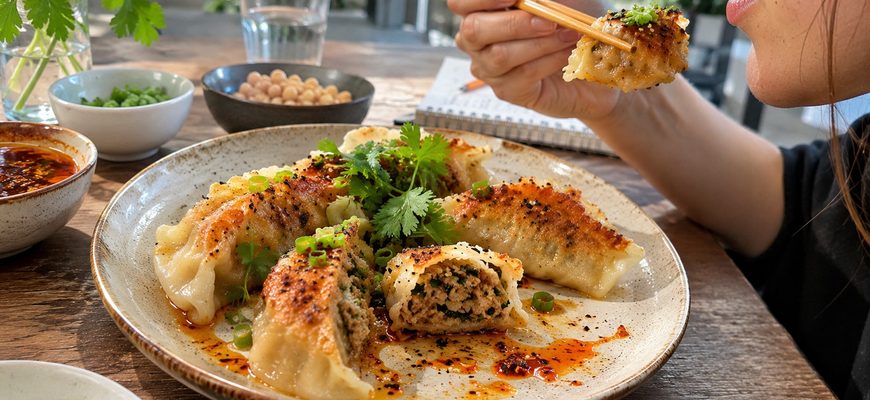
- Editorial images: Personal Creations, CC BY 2.0 and Robi313, CC BY 4.0. Both photographs are expressly described as illustrations or product photographs, not images of the Stanford taste-test dishes.