A data center’s servers can be healthy while the building’s control network has lost contact with the equipment that cools them. Whether the room immediately begins to heat up depends on something less visible than the network outage: where the control decisions are made. Some pumps, fans and valves can continue operating under local controllers. Others rely on communication with shared sensors, supervisory systems or other controllers. The same apparent failure on an operations dashboard can therefore have very different physical consequences.
The key distinction is between the IT network carrying application traffic and the building automation system, often called the BAS or BMS. An operational technology (OT) network can connect sensors, programmable controllers, cooling equipment, electrical monitoring and supervisory workstations. NIST treats building automation as a form of OT in its Guide to Operational Technology Security. That system has its own reliability concerns even when the data center’s compute network is working perfectly.
A data hall can lose visibility before it loses control
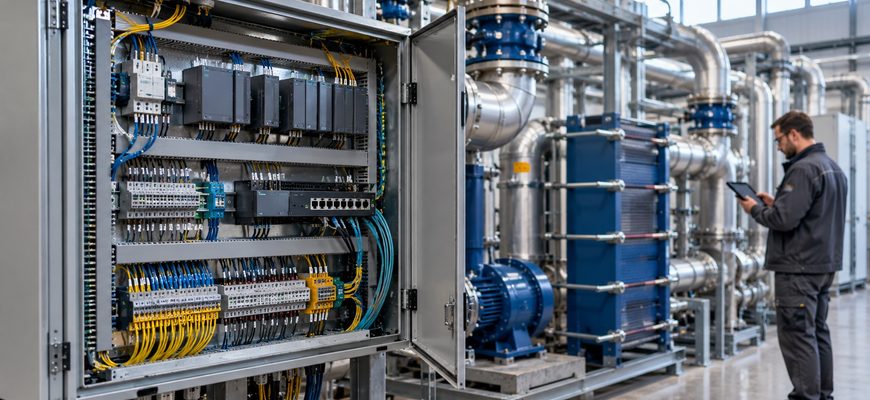
In a typical layered building automation design, a supervisory workstation collects measurements, displays alarms, lets operators adjust permitted settings and coordinates some equipment. Closer to the machinery, field controllers run control logic and exchange information with sensors and actuators. A controller may regulate a fan speed or valve position using readings wired directly to it, without needing a constant stream of commands from the main dashboard.
If the connection to the supervisory system goes away, locally hosted control loops may continue using their most recent settings. The central console can appear empty or stale even as pumps circulate water and air handlers continue to move air. That is an intentional resilience feature when it has been designed, configured and tested—not a property every building-control system automatically possesses.
The BACnet Committee describes BACnet as a communications standard for building automation devices. A BACnet-connected network can carry values and commands between systems, but the presence of a standard protocol alone does not determine what a particular actuator does after communication is lost.
A broken field network can be a different failure entirely
Suppose the controller needs a supply-water temperature reading from another panel across an OT network. If that communication path fails, the controller may no longer have the variable needed for normal regulation. What it does next depends on its configured fault behavior: hold the previous output, switch to a local input, apply a predefined default, switch to a safer state or stop. Those outcomes are engineering choices and must be verified in the site’s documentation and failure tests.
The situation becomes more complicated when multiple cooling machines coordinate. A chilled-water plant can have separate controls for pumps, chillers, dry coolers, valves and air-handling units. A single local pump controller cannot always compensate for the loss of the supervisory sequence that normally decides which machines should be active, or whether a standby unit should start.
That is why “the BMS is down” is an incomplete diagnosis. It could mean the operator’s screen is unreachable, the supervisory server has crashed, a field communications segment is isolated, or a controller itself has failed. The observable data hall temperature might initially look the same in all four situations while the remaining safety margins differ substantially.
| What failed | What could continue | Main uncertainty |
|---|---|---|
| Dashboard to plant network | Independent local controllers may keep regulating normally. | Alarm visibility and coordination might be lost. |
| Controller to remote sensor | Other equipment and local instruments may work. | Missing measurement can trigger a fallback, hold or shutdown. |
| Controller to actuator or drive | Some equipment may follow a configured last-safe state. | Actual output depends on drive, actuator and safety logic. |
| Shared plant coordination | Individual equipment may still operate locally. | Chiller/pump staging, standby changeover and optimization may fail. |
| Controller power or hardware | Other healthy controllers can remain active. | That control loop may cease functioning entirely. |
Cooling failures can develop while the servers are still energized
A rack does not immediately shut off because a BMS workstation loses a connection. The servers continue drawing power and producing heat. If cooling distribution continues, the room may stay within limits for the entire network interruption. If a valve closes, a pump fails to start or the supply-air system falls back to an unsuitable state, temperatures can begin drifting while the IT hardware still reports that it is running.
This difference between electrical availability and heat rejection matters. IL.DIGITAL previously followed a cooling failure in a powered data center, showing why uninterrupted server electricity says little about whether heat is leaving the building. An OT failure introduces a subtler version of the same risk: an operator can lose reliable visibility or coordination before the thermal consequence becomes obvious.
The effect need not be uniform. One cooling zone may keep its local control loop while another relies on a shared sensor or central sequence. As explained in our article on heat recirculation across a rack, localized inlet conditions can differ significantly from a general room or plant reading. A stale BMS summary is a poor substitute for independent measurement at critical equipment.
Where alarms and safeguards should live
A well-designed control architecture does not rely on one screen for every important protective action. Local controller logic, hardware interlocks, redundant sensors, independent protective devices and properly tested fail-safe states can provide layers of resilience. However, the presence of a backup sensor or redundant controller does not prove that a shared switch, power supply or configuration cannot defeat both.
NIST SP 800-82 emphasizes OT’s distinct requirements for safety, reliability and availability, and treats segmentation and asset management as part of securing an OT environment. A data center may deliberately separate its building-control network from ordinary user-facing IT traffic, but segmentation alone cannot prevent a failed OT switch from affecting its own controllers.
The BACnet building automation standard facilitates communication between equipment from different manufacturers. Interoperable messaging is valuable, but it cannot replace a site-specific answer to a more important operational question: what happens when those messages stop arriving?
Operators may lose alarm dashboards, trends or remote commands while a self-contained local loop remains in service.
If field inputs, controller execution or critical outputs are lost, physical equipment may enter a defined fallback or stop.
How operators can test the boundary without risking live cooling
The relevant engineering artifacts are control narratives, network diagrams, points lists, controller programs and documented failure sequences. They show where a sensor is read, which device calculates a command, who receives the alarm and what happens after a timeout. A dashboard screenshot alone cannot answer those questions.
For commissioning and planned resilience testing, engineers can use approved procedures to verify isolated segments, local control behavior, alarm routing and recovery; such tests should be scheduled and conducted by qualified staff, not by deliberately disconnecting live plant networks without a coordinated plan. A meaningful test records physical equipment response, not merely that the BMS console displayed an offline icon.
Cooling also depends on physical infrastructure beyond communications: water quality, airflow paths and equipment condition. Our reporting on air quality damaging servers despite ordinary temperature readings is a reminder that one “green” metric never certifies the health of an entire environment.
The practical distinction: an unavailable management screen is a loss of visibility. An unavailable local controller or field path can become a loss of physical control. The building’s fault response—not whether the server racks are still lit—determines how much cooling margin remains.