A standby generator can start, sound healthy and still leave a data center unprepared for a blackout. Starting proves that the engine can run. It does not prove that the electrical system can accept the building’s load—or that the building will ever connect to it.
Data center generator testing therefore asks several different questions. Can the machine start from standby? Can it sustain a demanding load? What happens when that load changes suddenly? And does the complete backup-power sequence keep the intended equipment operating?
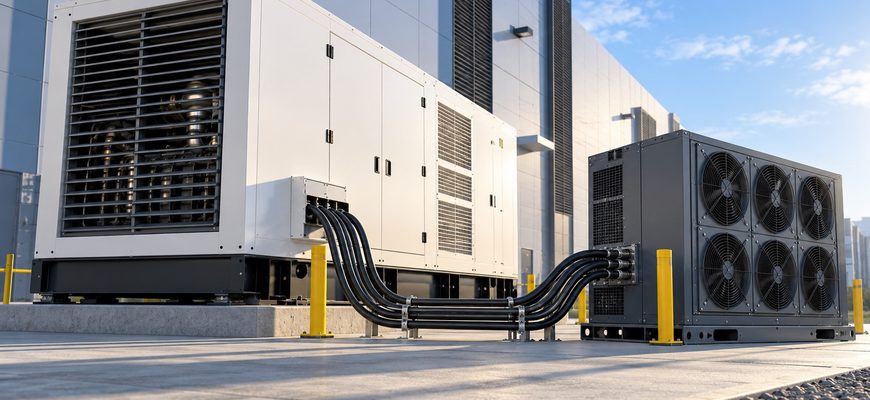
The distinction is visible in a piece of equipment parked beside the generator: a load bank. It lets engineers ask the machine for substantial electrical output without using the production servers as the test load.
The load bank turns electricity into evidence
A resistive load bank is essentially a controllable set of electrical heating elements with cooling fans. It consumes real power in measured steps. Avtron’s load-bank guide describes how these devices provide a repeatable load for evaluating power-system performance.
That makes a loaded run very different from an engine exercise with little electrical demand. The engine must deliver torque, the alternator must produce output, and the cooling and fuel systems must support the resulting operating condition. Engineers can observe whether temperatures, pressures and electrical output remain acceptable as the test continues.
Cummins also identifies wet-stacking as a reason to exercise diesel generators under load. Extended light-load operation can leave a diesel engine below its intended operating temperature, contributing to deposits and compromised performance. Running longer at negligible load is not automatically an adequate substitute for an appropriate loaded test.
The missing part may be outside the test circuit
A load bank connected to the generator does not automatically exercise the site’s transfer equipment. The temporary test circuit might carry power through a different route from the one that supplies the data hall.
ABB’s ATS022 transfer-controller manual makes this boundary explicit: it distinguishes a generator start-and-stop test from a complete switching test. In the former, the engine can run without the controller operating the line circuit breakers. This is a documented example of test scope, not a claim that every facility uses that controller.
Which route did the test actually exercise?
Load bank accepts a controlled electrical load.
Transfer equipment → site distribution → required loads.
A broader exercise examines the sequence: the control system recognises the simulated source problem, requests generator operation, accepts the alternate supply and transfers the intended loads. The return to normal supply matters too. A successful transfer followed by an unsuccessful return leaves the installation in a different state from the one the test was meant to restore.
The result must say which sequence was exercised. “Generator passed” is too vague if the unresolved question concerns a transfer switch, a downstream breaker or a cooling-system restart.
Holding the load is different from catching it
A generator may hold a steady load satisfactorily yet struggle during its arrival. Engineers examine the voltage and frequency excursion when demand changes and the time taken to recover—not just the settled reading afterwards.
Cummins’ data-center generator specification guidance explains why the UPS is part of this interaction. Depending on its design and settings, it can initially support the load from batteries and then ramp its input onto the generator. A voltage or frequency disturbance can cause the UPS to reject the source and return to battery support.
The test should represent the intended sequence and load behaviour. A headline requirement to accept everything in one sudden step may describe a different operating case from a site designed to add loads progressively. Equally, a gentle laboratory ramp does not establish that an installation will survive a harsher transfer or failover.
AI workloads add another reason to define the boundary. GPU demand can change rapidly, but power conversion and storage shape what upstream equipment sees. The relevant test profile is the demand reaching the generator, not an unqualified copy of chip-level telemetry.
“Full load” needs units
Resistive loading at unity power factor tests real power in kilowatts. It does not reproduce every current and power-factor condition associated with the same generator’s apparent-power rating in kilovolt-amperes. Avtron explains why combined resistive and reactive loading is used when that wider capability needs evaluation.
For an illustrative rating of 2 MW at 0.8 power factor, apparent power is 2 ÷ 0.8 = 2.5 MVA. A purely resistive 2 MW load is 2 MVA. It reaches the assumed real-power rating while representing only 80% of that apparent-power rating. These are assumed values, not specifications for a particular generator.
This does not make a resistive test inadequate by definition. It makes the phrase “tested at 100%” incomplete without the rating, load type and acceptance criteria.
The quiet checks explain whether it will start again
The electrical trace cannot replace maintenance. Starting batteries, their charger, coolant heaters, fluid levels and leaks all influence readiness. Cummins’ maintenance guidance includes those supporting systems alongside running checks. The relevant inspection programme must match the installed equipment and service conditions.
Fuel deserves more than a level reading. Cummins’ fluid-analysis programme describes testing fuel for conditions associated with filter plugging, poor injector performance and loss of power, and coolant for imbalances in its constituents. A tank containing enough liquid is not the same evidence as a suitable fuel supply.
At facility level, powered servers still depend on working cooling. An integrated exercise needs to address the support loads and controls within its scope. Schneider Electric’s integral systems testing description emphasises evaluating infrastructure together under simulated conditions, rather than treating individual equipment passes as proof of the complete installation.
The useful record names the connected load, operating conditions, duration, transfer sequence, measured response and unresolved defects. After the exercise, readiness also includes the restored standby configuration and replenished resources. No single successful run establishes performance under every future condition.
Before the next blackout, the decisive question is not simply whether the generator was tested. It is whether the test reached the part of the system you are relying on.
Sources
- Avtron: Load Banks for Power System Testing — load types, real power and apparent power.
- Cummins: Load Bank Performance Testing — loaded exercise and wet-stacking.
- ABB: ATS022 manual, section 5.7 — generator-only and complete switching tests.
- Cummins: Specifying Standby Generator Set Requirements for Data Centers — load acceptance and UPS interaction.
- Cummins: Generator readiness and maintenance guidance; Generator Fluid Analysis Program — supporting systems and fluid condition.
- Schneider Electric: Integral Systems Test Service — evaluating installed infrastructure as a system.