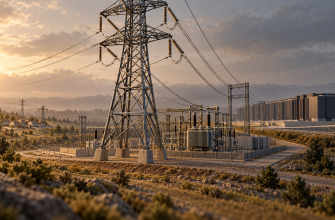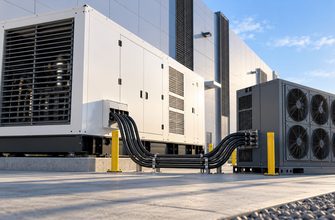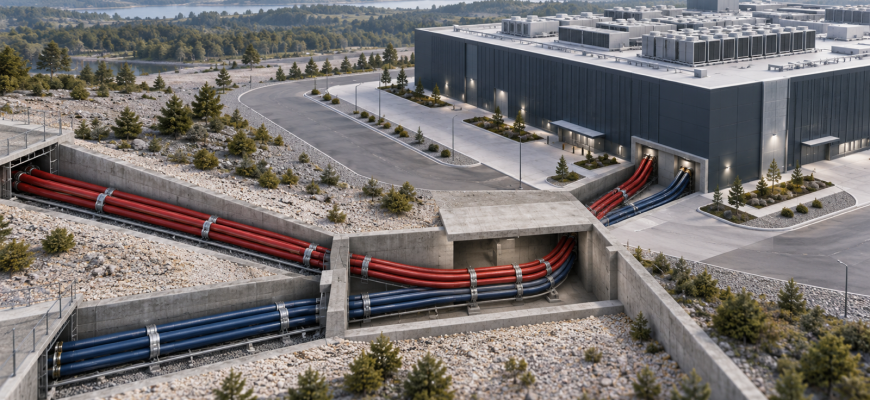
- Start at the server, then follow both cables backwards
- Different entrances, one shared dependency
- A common failure does not need a common cable
- The second path needs room for the first path’s load
- A real outage crossed several layers of protection
- Move the boundary far enough to protect the service
- Sources
Two power cables entering a building tell you where electricity arrives. They do not tell you how far back those cables remain independent.
A data center’s two power feeds might share a substation, a route through the ground, or equipment inside the building. Alternatively, both feeds might work perfectly until the loss of one overloads the other. The useful question is what a particular pair of paths can survive together.
That distinction matters when an AI service depends on a room full of machines: redundant inputs protect only the failures the rest of the design can contain.
Start at the server, then follow both cables backwards
A dual-power server has separate power-supply inputs. In a suitable redundant configuration, one supply or feed can stop while the other keeps the machine operating. The rack’s power distribution units, or PDUs, distribute electricity to those inputs. Eaton’s explanation of dual-circuit PDUs describes giving the server’s supplies independent sources.
Follow the two paths towards their sources. Do they reach different UPS systems, which provide short-term backup power? Different switchboards? Separate utility connections? At each step, the answer changes which equipment failures remain survivable.
Schneider Electric explicitly notes that nominally separate paths may meet upstream at a panel, a UPS or the utility supply. Two sockets therefore do not establish two complete, independent power systems.
Different entrances, one shared dependency
Backup systems must carry the site.
A common failure does not need a common cable
Imagine two otherwise separate feeder cables crossing the same service trench. Damage to that trench could affect both without the cables sharing an electrical connection. This is an illustrative layout, not a claim about a particular facility. The distinction is between electrical separation and physical separation.
The same reasoning applies to equipment placed in the same vulnerable room. Drawing two lines on an electrical diagram cannot establish that water, smoke or maintenance access will affect only one of them. A dependency review needs the physical layout as well as the circuit topology.
Infrastructure designers also distinguish maintainability from fault tolerance. In Uptime Institute’s Tier descriptions, Tier III concerns planned maintenance without interrupting operations; Tier IV adds fault tolerance. Calling a building “redundant” leaves that distinction unresolved. The specific certified scope and actual operating configuration matter more than counting incoming cables.
The second path needs room for the first path’s load
There is another way to lose both paths without a shared component breaking: one fails, its load transfers, and the survivor is overloaded. Schneider’s dual-path guidance stresses that a failure on one side must not overload any point on the alternate route.
Consider a deliberately simplified example. A rack draws 24 kW, split equally between A and B. Each side normally carries 12 kW. If either side has only 20 kW of usable capacity, normal operation looks comfortable, but the survivor cannot carry the full 24 kW. These are assumed values, not a measured rack or an electrical design recommendation.
The actual calculation must include the equipment’s supply configuration and the limits of every relevant circuit. A larger electrical distribution voltage, such as the move towards 800-volt power for AI infrastructure, addresses a different question. Voltage alone does not establish independent paths or adequate capacity after a failure.
A real outage crossed several layers of protection
Cloudflare’s November 2023 account of its control-plane and analytics outage shows why multiple supplies are only part of the story. It reported an initial utility-feed loss at the Flexential facility it called PDX-04, followed later by a ground fault and loss of generator power. UPS batteries then ran out before power was restored.
Cloudflare labelled parts of its account of the electrical sequence as informed speculation, pending confirmation from the operator and utility. It should not be treated as a fully settled forensic explanation of every switching decision.
The documented service consequence is clearer: some supposedly highly available services depended on systems in that facility. Cloudflare said it had not tested taking the entire PDX-04 site offline. Physical redundancy and software independence both needed examination.
Move the boundary far enough to protect the service
Even a server that retains electricity still needs other working systems. Cooling can stop while electrical power remains available. Two server inputs do not duplicate the cooling plant, network or application database.
For a service that must survive the loss of a facility, a second rack in the same building may leave the important dependency untouched. AWS’s description of Availability Zone isolation makes the broader design goal explicit: separate power infrastructure, no shared generators or cooling equipment across zones, and physical distance intended to reduce correlated failures.
That infrastructure provides places to distribute a service; the application must actually use them. A surviving location needs the data, capacity and working dependencies required to serve requests.
When someone offers “two feeds,” ask them to trace both routes and name the event that still defeats them. The answer defines the protection you are buying.
Sources
- Eaton: PDU installation options — dual-circuit source arrangements.
- Schneider Electric: redundancy in a dual-path distribution system — shared upstream points and surviving-path capacity.
- Uptime Institute: Tier Certification — maintainability and fault tolerance.
- Cloudflare: November 2023 outage postmortem — operator account with explicitly identified uncertainties.
- AWS: Availability Zones — physical fault-isolation boundaries.