- What this new architecture reveals
- What is AMD Helion?
- An AI agent is more than a model generating tokens
- Where the work happens
- What should the CPU handle, and what should the GPU handle?
- Agent execution
- Model inference
- The slowest part of an agent may not be the model
- Where total task time goes
- Why AMD offers CPU-only and combined CPU/GPU racks
- CPU-only: an execution tier beside an existing AI platform
- Combined: CPU execution and GPU inference together
- What AMD has established — and what it hasn’t
- Scaling agents means scaling the systems around the model
- How do you know whether an agent rack is useful?
- Test completed tasks, not marketing specifications
- AI infrastructure is becoming more than an accelerator count
- Sources and reporting notes
An AI agent asks a language model what to do next. Then it reads a document, calls an API, checks a database, executes a script and saves the result. The model may be the cleverest part of that workflow, but it is not doing all the work.
In October 2026, AMD introduced something that makes this distinction unusually visible: an AI server-rack design that can contain no GPUs at all.
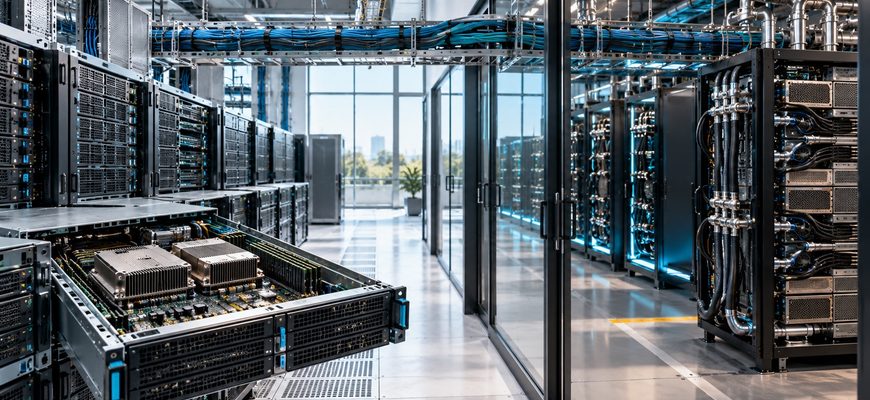
The platform is called Helion. Its CPU-only configuration is intended to execute large numbers of AI agents, while connecting them to separate infrastructure that handles model inference. Another configuration combines CPU servers and GPU accelerators within one rack.
That might sound strange in an industry where AI hardware announcements usually begin with enormous GPU counts. But it raises a useful question: what does an AI agent actually need a GPU for, and what work is happening on ordinary server CPUs?
What this new architecture reveals
- An AI agent is a software workflow that may make repeated model calls and perform many other operations.
- CPUs can coordinate tools, execute application code and manage the services around a model.
- GPUs remain useful for accelerating demanding model inference, even when the agent runs elsewhere.
- AMD Helion offers both CPU-only and combined CPU/GPU designs. The announced capacities are specifications, not benchmarks.
- The important measurement is useful completed agent work at an acceptable latency and energy cost.
What is AMD Helion?
AMD announced Helion on October 12, 2026, during the Open Compute Project Global Summit. The company describes it as an open rack-scale blueprint built around AMD EPYC server processors and, in some configurations, AMD Instinct GPUs.
Helion is not one fixed machine. It is a reference design with different ways to arrange CPU execution, model inference and supporting infrastructure.
The CPU-only design is aimed at large operators that already have separate GPU inference infrastructure. The integrated design is intended for customers who want CPU and GPU resources together in one rack.
AMD says the platform uses an Open Compute Project-based approach and can support air- or liquid-cooled deployments. The company’s product materials describe an ORv3 rack design and a range of CPU blade types.
There is also an important timing distinction. At announcement, AMD said partner configurations were under development, with availability planned for November 2026. That is a plan, not evidence that all configurations are already deployed.
02 / WHAT THE AGENT DOESAn AI agent is more than a model generating tokens
Imagine an agent responsible for preparing a supplier report. A model might decide which information to request or how to summarize the findings.
But the surrounding application still needs to authenticate the user, read files, call external services, handle errors, execute permitted functions and store the report.
Those tasks do not all require the same hardware.
A language model uses computation to process tokens and generate an output. An agent runtime manages the sequence of operations around those calls.
The OpenAI Agents SDK, for example, documents an execution loop in which a model response can trigger tool calls or handoffs before another model call. The application runs the requested tools and returns their results to the loop.
In practical systems, much of this surrounding application code can run on CPUs.
That is the distinction AMD Helion is designed to address at rack scale.
Where the work happens
-
The application accepts a task
— CPU / service
Request handling, permissions, application state and routing begin in ordinary server software.
-
The model proposes a step
— inference
A model evaluates context and may request a tool action. Demanding inference can run on a GPU elsewhere.
-
The tool executes
— CPU / external service
Code runs, a database is queried, or an external API receives a request. Some time may be spent waiting for I/O.
-
The model receives the result
— inference
The application passes the relevant tool output back for another model step.
-
The workflow completes
— CPU / storage
The application validates, records and delivers the final result.
Simplified execution example. Workload placement varies by application. A CPU may also run smaller models, while external tools may execute on entirely separate infrastructure.
For a closer look at the boundary between a model’s decision and a software action, see our earlier explanation of how AI agents use tools .
03 / CPU VERSUS GPUWhat should the CPU handle, and what should the GPU handle?
CPUs are general-purpose processors designed to run a wide variety of application workloads. They can execute control logic, manipulate data, communicate with services and manage many concurrent tasks.
GPUs are highly parallel processors. They are particularly effective for many of the matrix operations used by large AI models.
These capabilities complement one another. They are not mutually exclusive.
Agent execution
Orchestrating steps, running application code, handling requests, managing state, processing data and interacting with tools or databases.
Model inference
Accelerating the mathematical operations needed by demanding language, vision and other machine-learning models.
Now imagine thousands of agents sharing one GPU model service.
Each agent may spend part of its lifetime waiting for an API, processing a file or managing intermediate application state.
Keeping every aspect of that workflow tightly coupled to a GPU server may be unnecessary in some architectures.
A separate CPU execution tier can run the application work while GPU inference is provided by a shared model service. The two tiers can then be sized and scaled for different demands.
That does not make the GPU irrelevant. If the agent needs a powerful model, the model still has to run somewhere.
Important distinction: a CPU-only Helion rack does not mean the full AI application uses no GPUs. It means the rack can be dedicated to agent execution while model inference is supplied by separate systems.
The slowest part of an agent may not be the model
A conventional model benchmark might report how many tokens an accelerator generates per second.
That can be important, but a multi-step agent also experiences other delays.
A database query can be slow. An external service may have a rate limit. A tool process may wait for a file or a network response. Another model call may enter a queue.
Even when the individual model calls are fast, the overall task can take much longer.
Where total task time goes
The CPU is not necessarily the bottleneck in all those situations. A process waiting for a remote API may use very little CPU time.
That is why a serious infrastructure evaluation must distinguish CPU utilization, I/O waiting, inference latency and the total time to finish a task.
Simply adding more CPU cores will not accelerate an overloaded remote API or a saturated GPU inference queue.
Equally, adding more GPU capacity will not automatically resolve slow storage, inefficient tool execution or a congested database.
05 / WHY TWO RACK DESIGNSWhy AMD offers CPU-only and combined CPU/GPU racks
AMD’s split reflects two different infrastructure arrangements rather than one universal answer for every business.
CPU-only: an execution tier beside an existing AI platform
A hyperscale operator may already operate large GPU inference clusters.
In that environment, agent runtimes can be deployed separately. They issue inference requests over a network, then carry out tool and application work on CPU servers.
This separation offers flexibility: the number of agent workers and the capacity of the model service can be adjusted independently.
But it also introduces physical network dependencies between the execution tier and the model service.
Combined: CPU execution and GPU inference together
An enterprise may prefer a rack that includes both CPU nodes and GPU inference equipment.
AMD describes an integrated configuration using EPYC CPU nodes, Instinct MI350P GPU nodes and general-purpose computing resources.
This arrangement can place more of the agent system within one hardware deployment, although it does not eliminate network, software or operational complexity.
The decision depends on available infrastructure, security requirements, workload size, latency targets, equipment cost and operating conditions.
What AMD has established — and what it hasn’t
The first two points describe the manufacturer’s proposed architecture. The latter two would require independent application benchmarks with well-defined workloads and measured operating conditions.
06 / THE OPERATIONAL CONSEQUENCEScaling agents means scaling the systems around the model
If an agent can perform several operations before delivering a result, every additional concurrent agent can create demands on other systems.
More tools may mean more database connections. More active workflows may require additional memory and persistent state. More requests may increase pressure on model serving.
Retries and failures add another layer. A task may restart after an interruption, or need to continue from saved progress.
We previously examined how AI agents can recover after a crash . Reliable execution depends on more than fast inference: durable state, correctly handled actions and recoverable workflows all matter.
The same principle applies to storage. Our analysis of n8n execution history filling an SSD illustrates how seemingly lightweight automation can create a physical storage burden.
AMD’s Helion proposal brings these supporting workloads into the hardware discussion.
An operator evaluating an agent fleet should therefore consider the entire chain, not just the processor running the model.
07 / WHAT TO MEASUREHow do you know whether an agent rack is useful?
A CPU-core count describes potential execution resources. It does not tell an operator how much useful work a real agent system will complete.
For that, the evaluation must use end-to-end application measurements.
Test completed tasks, not marketing specifications
Proposed experiment only. il.digital has not independently benchmarked an AMD Helion rack. No performance results are implied by this methodology.
The most revealing result may not be the maximum number of agents launched. It may be the point where adding another agent stops increasing completed useful work.
If CPU utilization is low while GPU inference queues are growing, the model service may be the constraint.
If model calls return quickly but tool processing becomes slow, the execution tier deserves closer attention.
If both are underutilized while tasks wait for an external service, buying more compute may do very little.
AI infrastructure is becoming more than an accelerator count
AMD Helion is notable because it treats agent execution as a distinct infrastructure requirement rather than assuming every AI workload belongs inside the same accelerator-heavy server.
The underlying idea is not that CPUs replace GPUs. It is that AI agents involve several kinds of work, and each kind imposes different demands on machines.
The practical question for an operator is no longer simply how much inference capacity to buy. It is how to balance model computation against the applications, tools, storage and networks that turn model output into completed tasks.
A GPU can generate the next instruction. The rest of the infrastructure still has to make it happen.
Sources and reporting notes
Helion specifications and deployment plans come from AMD documentation. Agent execution behavior is discussed using published software documentation. No Helion hardware was tested by il.digital for this article.
- AMD Newsroom — Introducing AMD Helion, Agentic AI Compute at Rack Scale . October 12, 2026.
- AMD — Helion Agentic AI Rack . Official design options, processor configurations and published specifications.
- Open Compute Project — 2026 OCP Global Summit by the Numbers . October 2026 summit summary.
- OpenAI Agents SDK — Running Agents . Documentation of model calls, tool execution, handoffs and the agent execution loop.