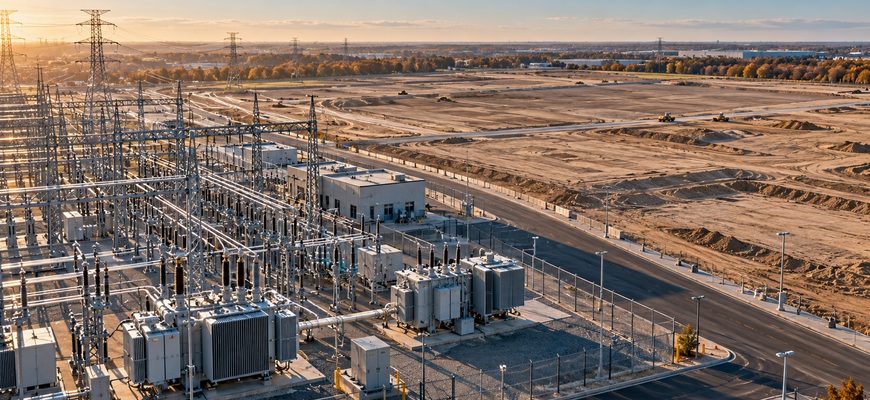
- Why an unbuilt data center matters
- The electricity request can arrive years before the servers
- Why a request on paper can trigger real electrical engineering
- How a proposal becomes a grid commitment
- Developer requests capacity
- Utility studies the network
- Required upgrades are identified
- Financial commitments are secured
- Power is delivered if the project advances
- Exelon says it has secured more than $1 billion in customer protections
- The scale of the commitments
- Not every proposed data center belongs in the same category
- Five signals of increasing commitment
- Why headline gigawatts can mislead
- Could ordinary electricity customers end up paying?
- Building too much is not the only problem
- The power grid needs evidence, not just bigger promises
- Five questions before trusting a giant AI power announcement
- Sources and Reporting Method
Somewhere in America, a utility is being asked to reserve electricity for a data center that may not exist for years. The proposed building could contain thousands of AI accelerators. It could also never be built.
That uncertainty would be manageable if the request existed only on paper. But electrical infrastructure does not appear overnight. Connecting a large computing campus can require grid studies, substations, transformers, transmission upgrades and long-term capacity planning.
Energy companies must decide which projects deserve those preparations before every developer has completed construction, secured financing or signed an electricity service agreement.
In 2026, that problem has become important enough to earn an unusual name: phantom data centers.
They are not imaginary computers secretly consuming power. They are proposed facilities whose place in electricity demand forecasts may be much more certain than their eventual construction.
Why an unbuilt data center matters
- A request for electrical capacity is not proof that a data center will be completed.
- Multiple preliminary requests, uncertain financing and changing development plans can distort electricity demand forecasts.
- Utilities must prepare real infrastructure before future computing demand is certain.
- Contracts, collateral and project milestones help separate committed customers from speculative requests.
- The financial risk depends on who ultimately pays for infrastructure that is not fully used.
The electricity request can arrive years before the servers
Imagine a developer planning a new 500-megawatt data center campus.
Before construction begins, the developer needs to know whether the electrical grid can provide that power. The company may approach utilities, evaluate several potential sites, request engineering studies and investigate different connection dates.
Some of those inquiries may represent alternatives for the same eventual project. Others may be early commercial ideas that have not secured tenants or financing.
From the perspective of a utility, however, each request may represent a substantial future electrical load.
The difficulty is deciding when that possibility should become part of an official investment and demand forecast.
A megawatt requested is not necessarily a megawatt that will ever be consumed.
The Electric Power Research Institute identified this problem in its 2026 electricity demand analysis. EPRI noted that utility forecasts can count the same data center project more than once when developers submit multiple connection requests.
EPRI also warned that uncertainty around actual construction and the pace of AI adoption makes demand forecasts unusually difficult.
This does not mean the AI infrastructure boom is fictional. Large data centers are being built and operating. The problem is how to distinguish their credible future demand from the much larger universe of proposals.
Why a request on paper can trigger real electrical engineering
Supplying a large data center is not as simple as adding another power cable.
Engineers need to examine available generation, transmission capacity, voltage levels, equipment ratings and network reliability.
Depending on the site, the connection could require a new transformer, switchgear, additional substation capacity or larger transmission upgrades.
These are physical objects with manufacturing schedules, construction costs and engineering constraints.

Some equipment must be ordered well before a planned facility begins using electricity. Grid studies and approvals can also take years.
That creates a difficult choice: begin preparing too early and risk spending money on demand that never appears, or wait for certainty and potentially delay a genuine customer.
The Congressional Research Service reported in September 2026 that building new grid infrastructure typically takes longer than building data centers themselves.
How a proposal becomes a grid commitment
-
01
Developer requests capacity
The developer identifies a proposed electrical load, location and target connection date.
-
02
Utility studies the network
Engineers evaluate whether the transmission and distribution system can support the proposed load.
-
03
Required upgrades are identified
Plans may involve transformers, substations, new lines, protection equipment or additional supply.
-
04
Financial commitments are secured
Contracts, deposits or other guarantees establish how project-related financial risk is allocated.
-
05
Power is delivered if the project advances
Completed facilities connect and ramp their electrical demand, sometimes in stages rather than all at once.
Simplified planning sequence. Actual interconnection procedures, security requirements and upgrade timing differ between jurisdictions and utility service territories.
Exelon says it has secured more than $1 billion in customer protections
One of the clearest responses to this planning problem comes from Exelon, a major US utility company.
On August 4, 2026, Exelon announced that it had secured more than $1 billion in financial protections through agreements intended to make large new electricity customers responsible for their share of transmission-service costs.
The arrangements are called Transmission Security Agreements, or TSAs.
They require major electricity users, including data center developers, to make financial commitments related to their projected transmission needs.
The intention is to reduce the risk that existing customers must cover costs created by new projects that are delayed, scaled back or abandoned.
The scale of the commitments
Financial protections announced by Exelon in August 2026.
Combined advanced ComEd and Mid-Atlantic load identified in Exelon’s July 2026 investor materials.
Figures reported by Exelon in its August 4 announcement and July 30, 2026 earnings presentation. Collateral is not the same as electricity sales, realized expenditure or a payment already made to consumers.
Exelon’s July 2026 presentation distinguished approximately 11 GW of high-probability data center load from a much larger future pipeline.
That distinction is central to the story. A project moving through advanced design or secured by a binding commitment is not at the same stage as an early expression of interest.
Financial guarantees cannot ensure that a data center will ultimately be completed. They can, however, make speculative reservations more costly and clarify who may bear certain costs if demand disappears.
This is a practical way of asking developers to demonstrate that their electricity request carries a meaningful financial commitment.
Not every proposed data center belongs in the same category
The term “phantom” is dramatic, but it can hide an important distinction.
A developer evaluating three locations for one large campus is not necessarily doing anything improper. The company may need preliminary utility feedback before deciding which location is viable.
Problems emerge when multiple possibilities are mistaken for multiple confirmed projects, or when uncertain proposals are treated as dependable future demand.
Five signals of increasing commitment
Editorial framework, not a regulatory project-rating system. No single milestone guarantees completion.
Even well-funded, serious developers can encounter delays in transformers, permits, utility connections, construction schedules or customer demand.
And a data center that is eventually built may initially use only a fraction of its ultimate designed electrical capacity.
This is why assessing the arrival date and ramp-up of electricity demand can be as important as assessing whether a building will exist at all.
Why headline gigawatts can mislead
In October 2026, analysts and industry publications drew renewed attention to the gap between proposed and likely completed data center projects.
Bernstein Research, as reported by Business Insider, estimated that only around 35% of a large announced US data center pipeline would materialize.
This is a proprietary analyst estimate based on project credibility, not an official count of canceled facilities and not a measured nationwide completion rate.
The more useful lesson is that several numbers commonly discussed together describe different things.
| Number | What it means | What it does not prove |
|---|---|---|
| Announced capacity | Planned or proposed project scale. | Completion or operational demand. |
| Connection requests | Capacity sought through utility planning processes. | Unique, financed projects. |
| Secured capacity | Capacity with stronger agreements or commitments. | Immediate, full utilization. |
| Operating load | Electricity actually consumed by connected equipment. | A project’s maximum planned size. |
An AI campus advertised as a multigigawatt project may be developed in several phases. A developer might request capacity for its final build-out while energizing only its first buildings years earlier.
A utility that treats all requested capacity as immediate and certain demand risks making the wrong investments at the wrong time.
Could ordinary electricity customers end up paying?
Potentially, depending on the electricity market, contractual arrangements and rules governing how infrastructure costs are recovered.
Transmission lines, substations and power plants have substantial fixed costs. When infrastructure is built for an expected customer that never arrives, somebody still has to cover the remaining expenses.
Those costs might fall on developers, utility investors, other customers or a combination of parties. There is no universal rule automatically charging every household for every abandoned project.
The risk is nevertheless real enough to influence utility regulation.
In an August 2026 analysis, energy research organization RMI modeled how planning for uncertain data center demand could affect power-system investment and consumer costs.
Its results showed that overbuilding generation for demand that does not arrive can increase system costs. The consequences depend heavily on which infrastructure gets built and how the costs are allocated.
Building too much is not the only problem
Infrastructure may be underused when expected computing demand is delayed or withdrawn.
Genuine customers may face longer delays, while the grid has less flexibility to support new demand.
Qualitative planning trade-off. These boxes are not measurements or financial forecasts.
The goal is therefore not to reject every project that has not broken ground.
Instead, utilities need forecasts that reflect project maturity, realistic construction schedules, phased electricity requirements and enforceable financial commitments.
The power grid needs evidence, not just bigger promises
On October 27, 2026, Wood Mackenzie’s large-load industry webinar agenda included phantom projects, transformer bottlenecks and ways to distinguish real future demand from speculative proposals.
The agenda reflects a wider engineering problem: utilities need credible signals about exactly when, where and how much electricity new customers will actually use.
The most useful signals include verified site progress, construction milestones, signed service agreements, deposits and a realistic load ramp-up schedule.
Stronger screening also has to remain fair to projects that need preliminary grid information before they can commit to a site.
Five questions before trusting a giant AI power announcement
- Is the quoted power a request, reservation or operating load? These are very different stages.
- Does the developer control the site? Land, permits and financing reveal whether a project is advancing.
- Are utility commitments binding? Engineering studies alone do not guarantee construction.
- When will power actually be used? A multiyear phased build cannot be treated as full demand tomorrow.
- Who pays if the project stops? Contract terms and tariffs determine how financial risk is shared.
The scale of the problem becomes clearer when viewed alongside AI servers waiting for an electrical supply that has not arrived . In that case, the equipment is real while the required power is delayed.
Phantom demand presents the reverse uncertainty: the grid is being asked to prepare for computing equipment that may not arrive.
And when a project does move forward, designers face another physical challenge: delivering enormous electrical loads to dense AI racks .
Both sides of the problem matter. Electricity that cannot reach a completed data center delays valuable infrastructure. Electrical infrastructure built around a project that vanishes can impose costs without delivering the expected benefits.
The next generation of AI data centers will require more than processors and construction budgets. It will require a more trustworthy way to turn promised megawatts into real, measurable demand.
The most important number in a data center announcement may not be how much electricity it asks for, but how much of that demand someone is prepared to guarantee.
Sources and Reporting Method
- Exelon, August 4, 2026 . Transmission Security Agreements and financial customer protections.
- Exelon second-quarter investor presentation, July 30, 2026 . High-probability data center pipeline and collateral disclosures.
- Electric Power Research Institute, Powering Intelligence 2026 . Electricity demand forecasts, project uncertainty and potential double-counting.
- RMI, Planning for Uncertain Data Center Demand, August 6, 2026 . Independent system modeling, planning risk and cost allocation.
- Congressional Research Service, September 1, 2026 . Data centers, electricity demand, grid infrastructure and regulation.
- Wood Mackenzie, October 2026 . Industry agenda on large load interconnection and phantom projects.
- Business Insider, October 2026 . Reporting on Bernstein Research’s project-credibility estimate.
- Wikimedia Commons, Wikideas1 . Substation photograph, CC0 1.0 license.
Editorial methodology: figures are attributed to their original reporting organizations. Illustrative project sequences and qualitative comparisons are explanations, not measurements. No first-party developer survey, grid inspection, or financial audit was conducted for this article.