- Key Takeaways
- There is a difference between having the servers and having a data center
- The rack exists
- The site must catch up
- What has to happen before an AI rack can actually turn on?
- One new AI rack can demand up to 142 kilowatts
- Why can the chips arrive before the electricity?
- Grid availability
- Electrical equipment
- Commissioning
- Why buy expensive hardware before you can use it?
- Idle hardware does not always mean failed planning
- The AI industry is discovering a slower clock
- Four dates define usable AI capacity
- What should a data center operator measure?
- The next AI bottleneck may be outside the server
- Sources and Methodology
Imagine spending millions of dollars on some of the world’s most advanced AI computers, then discovering that the building meant to run them cannot supply enough electricity.
The machines are real. The GPUs have been manufactured. The racks have been assembled. But instead of answering questions or training models, some of that hardware is waiting for the rest of the infrastructure to catch up.
That is the tension behind a new report about Amazon’s AI expansion. It also exposes an increasingly important fact about the industry: buying computing power and making it available to customers are no longer necessarily the same event.
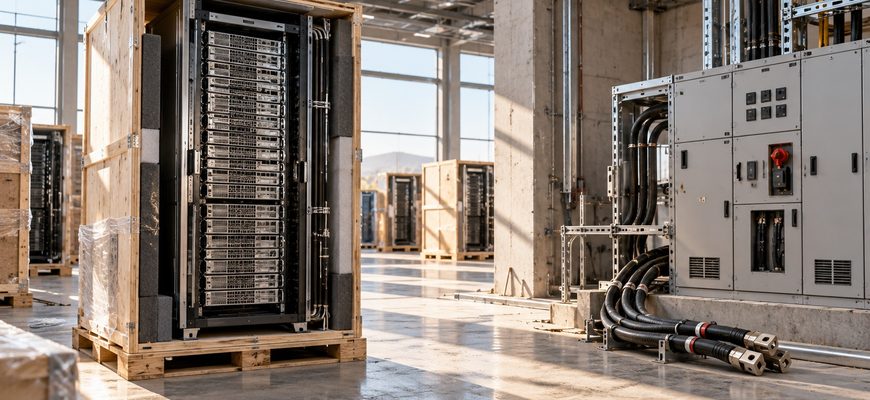
Business Insider reported that AWS was arranging early receipt of NVIDIA GB300 server racks, with some systems staged in warehouses while data center sites awaited sufficient electrical capacity.
The report cited internal emails describing approximately $5 billion in planned rack receipts and projections of further monthly deliveries. Those figures come from the publication’s reporting, not an independent inventory audit by il.digital.
Amazon confirmed that it stages equipment before deployment, describing the practice as normal operational planning, while disputing the suggestion that the broader company lacked a deployment path.
Key Takeaways
- A completed AI rack is not usable cloud capacity until the facility can safely power, cool, connect and commission it.
- NVIDIA documents a maximum power requirement of up to 142 kW for a GB300 NVL72 rack.
- Buying GPUs early can secure scarce hardware, but it can also leave capital tied up before the equipment generates revenue.
- The International Energy Agency says electricity connections and electrical-equipment supply chains are major constraints on AI infrastructure growth.
There is a difference between having the servers and having a data center
A finished AI rack looks like the final piece of the puzzle. It contains the accelerators, processors, high-speed interconnects and power hardware required to perform enormous amounts of computation.
But the rack is only one part of the installation. It also needs access to a facility designed to operate it.
That means the building needs enough delivered electrical power, the correct distribution equipment, dependable cooling, networking and systems that can withstand failures or fluctuations.
The racks can arrive before those systems are ready. A warehouse can protect and inventory expensive equipment. It cannot automatically turn that equipment into an operational AI cloud.
The rack exists
Accelerators, compute trays and networking hardware can be manufactured, tested, purchased and staged for installation.
The site must catch up
Utility capacity, electrical distribution, liquid cooling and commissioning determine whether the rack can run safely at its intended workload.
This is a scheduling problem with real financial consequences. Semiconductor supply chains and electrical infrastructure move at different speeds. Securing one before the other is ready creates a gap between hardware ownership and productive operation.
What has to happen before an AI rack can actually turn on?
The electricity used by an AI accelerator does not appear at the back of the rack by magic. It moves through a chain of physical systems, each with its own capacity, safety requirements and construction schedule.
A simplified large-scale deployment looks like this:
-
Utility power and grid connection
The site needs an approved, deliverable supply of electricity at the required capacity. Existing local grid infrastructure may need reinforcement.
-
Transformers and switchgear
High-voltage power is transformed, controlled and protected before it reaches the data hall.
-
UPS and rack power distribution
Power-quality, backup and distribution systems must support the electrical design and expected operational loads.
-
Cooling and facility services
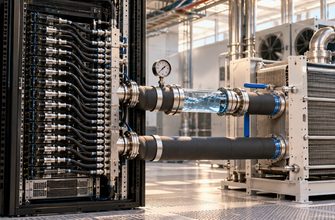
Liquid-cooled AI systems need compatible coolant distribution and functioning heat-rejection infrastructure before sustained operation.
-
Networking and commissioning
Engineers must validate installation, connectivity, monitoring, protection and workload readiness before declaring capacity available.
Failure or delay at any critical stage can hold up the final result, even when the rack itself is fully assembled.
In particular, a power constraint is not necessarily the absence of electricity in the building. There may be enough electricity for lighting, networking and some existing servers, but not enough additional committed capacity to operate the incoming equipment safely.
A free space on the data center floor is not the same thing as a free megawatt of electrical capacity.
One new AI rack can demand up to 142 kilowatts
The scale becomes clearer when we look at the hardware involved in the report.
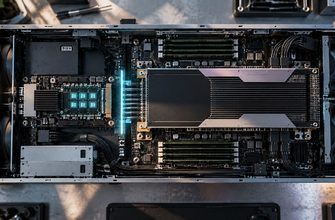
In its enterprise reference architecture, NVIDIA documents the GB300 NVL72 as a liquid-cooled rack-scale system containing 72 Blackwell Ultra GPUs and 36 Grace CPUs.
The same documentation specifies that a complete rack can require up to 142 kW of power. This is a maximum specification for that reference design, not a claim that every installed rack continuously draws 142 kW.
Now consider a simple illustrative calculation.
Seven racks at the stated maximum would account for almost one megawatt of IT power demand. This is a calculation from NVIDIA’s specification, not a measurement of an AWS installation.
And the servers are not the entire facility load. Pumps, cooling equipment, electrical losses, networking and other supporting infrastructure also consume electricity.
It would therefore be incorrect to assume that a site with one megawatt of total facility power can operate seven such racks at their stated maximum without additional capacity planning.
Our earlier investigation, Inside a 135 kW AI Rack: Where 90% of the Heat Goes, follows a related Lenovo GB300 design through its cooling system. The 135 kW figure there describes Lenovo’s published configuration; the 142 kW figure here comes from NVIDIA’s reference architecture. They should not be treated as identical design limits.
That cooling story also reveals why the power problem cannot simply be separated from the thermal problem: almost all electrical energy consumed by computing equipment ultimately becomes heat that must be managed.
Why can the chips arrive before the electricity?
A semiconductor supply agreement can move on one timeline. A grid connection can move on a much slower and more complicated one.
Server manufacturers can assemble hardware, complete testing and arrange shipping while a utility is still securing transformers, building a substation or upgrading transmission and distribution equipment.
The facility developer must also coordinate construction, environmental requirements, cooling equipment and commissioning. None of those can be solved by making the GPU chip itself faster.
In its April 2026 report, Key Questions on Energy and AI, the International Energy Agency identifies grid connections, electrical equipment, chip supplies and access to capital as interacting constraints on the industry’s expansion.
Grid availability
A site may not yet have sufficient contracted, deliverable electrical capacity for new AI racks.
Electrical equipment
Transformers, switchgear and power-electronics systems have their own manufacturing and delivery schedules.
Commissioning
Even after construction, integrated facility systems must be tested before they can support full workloads.
The problem is not restricted to one company. On October 18, Reuters, citing The Telegraph, reported that Microsoft had withdrawn from a proposed UK data center arrangement with Nscale after delays involving electrical grid access. The companies’ wider relationship was not described as ending.
These are separate reports concerning separate projects. Together with the IEA’s broader analysis, they illustrate why getting permission and physical capacity to draw power can be as strategically important as securing advanced processors.
Why buy expensive hardware before you can use it?
Waiting for perfect alignment sounds sensible until another constraint appears: the hardware itself may be difficult to obtain.
A cloud provider planning future AI capacity must make commitments long before every part of the facility is operational. Reserving scarce systems early can reduce the risk of missing a later deployment window.
But doing so shifts risk elsewhere.
If a rack is purchased or accepted into inventory months before it enters production, the company may have committed capital without yet making that rack available to paying customers.
The exact accounting depends on contractual terms and when the equipment is recognized, paid for and depreciated. Simply being stored does not establish a specific financial loss.
It does create a timing trade-off: hardware secured early can protect future supply, while delays in energizing a facility can postpone its productive use.
Idle hardware does not always mean failed planning
Some staging is deliberate. Companies routinely prepare equipment ahead of installation, and short-term storage can be part of a controlled deployment schedule.
The relevant question is whether the staging period is planned and bounded, or whether an unresolved power constraint is preventing the operator from turning purchased hardware into available capacity.
This is also why the term “dark GPUs” requires care. It is used informally for expensive AI systems that are not performing useful work, but it does not describe a single standardized technical state. Hardware awaiting installation, powered equipment left idle and GPUs underutilized by software are different operational problems.
The AI industry is discovering a slower clock
Chip development progresses through new architectures, faster memory and more efficient computation. Physical electricity networks follow another clock, governed by engineering, construction, regulation and local demand.
The contrast is becoming harder to ignore.
The IEA’s April 2026 assessment estimates global data center electricity consumption at approximately 485 TWh in 2025 and projects roughly 950 TWh by 2030 in its central outlook. Those are global estimates and projections, not a claim that every proposed data center will be built.
The same report notes that AI-focused data center demand is growing particularly quickly. But the impact is geographically uneven: a facility needs power where it actually stands, not merely somewhere on the national grid.
That distinction explains why broad claims that a country has enough generating capacity cannot establish that a particular development has a usable high-capacity grid connection.
And adding onsite generation is not automatically a quick solution. Power equipment, fuel infrastructure, permits, backup capacity and operating requirements introduce further dependencies.
Four dates define usable AI capacity
- Hardware delivery date When the rack is received and available for installation.
- Power availability date When adequate usable electrical capacity is confirmed for the site and workload.
- Facility commissioning date When power, cooling, networking and protection have passed required validation.
- Production availability date When the rack actually becomes ready to run workloads for customers or internal users.
A useful infrastructure metric would measure the gap between equipment delivery and production availability. Without that timing data, a purchase announcement says little about when customers will actually receive additional computing capacity.
What should a data center operator measure?
Before describing a new site as ready for AI workloads, an operator should be able to distinguish promised capacity from commissioned, usable capacity.
That means examining the electrical capacity available now, the actual rack power envelope, cooling readiness, commissioning progress and expected utilization.
A power usage effectiveness figure can help characterize facility energy overhead over a defined period, but it should not replace peak-load and electrical-capacity engineering. Average efficiency and the ability to safely energize a full rack are different questions.
The same distinction applies to AI performance. The number of GPUs a company has purchased is not the same as the number currently available to generate tokens or run training jobs.
The next AI bottleneck may be outside the server
The extraordinary part of modern AI hardware is how much computation can fit inside a single cabinet. The less visible part is everything required to keep that cabinet running.
The latest reporting about AWS is a reminder that a server rack can be finished long before the infrastructure around it is ready. That does not prove the purchase was mistaken, nor does it establish how long any particular system will remain idle.
It changes how we should evaluate promises of new AI capacity.
Until the electricity, cooling and commissioning are ready, the world’s most powerful AI hardware is still just hardware waiting for its first useful job.
Sources and Methodology
This article combines attributed reporting about AWS with published technical documentation and independent energy analysis. il.digital did not inspect AWS facilities, verify the internal emails independently or conduct first-party power measurements for this article.
- Business Insider, October 20, 2026 — AWS early rack receipt and power constraints.
- NVIDIA — GB300 NVL72 system hardware and rack power requirements.
- International Energy Agency, April 2026 — Key Questions on Energy and AI.
- Schneider Electric — GB300 data center reference design.
- Reuters, October 18, 2026 — Report on UK data center power connection delays.