Artificial Intelligence (AI) is a technology that allows computers to perform tasks that normally require human intelligence. These tasks include understanding language, recognizing images, making decisions, solving problems, and learning from data.
In simple terms, AI enables machines to analyze information and respond in ways that seem intelligent.
How Does AI Work?
AI systems are trained using large amounts of data. During training, the system learns patterns and relationships within that data. Once trained, it can use what it has learned to make predictions, answer questions, or complete tasks.
For example:
- A navigation app uses AI to suggest the fastest route.
- Streaming services recommend movies based on your preferences.
- Email providers use AI to detect spam messages.
- AI chatbots can answer questions and assist users.
What Is the Difference Between AI and Traditional Software?
Traditional software follows predefined rules written by programmers. If the situation changes, the software cannot adapt unless new rules are added.
AI works differently. Instead of relying only on fixed instructions, it learns from examples and data. This allows AI systems to handle more complex and unpredictable situations.
What Are Large Language Models (LLMs)?
Large Language Models, or LLMs, are a type of AI designed to understand and generate human language.
Popular examples include ChatGPT, Claude, Gemini, and many open-source models that can be run on local servers.
LLMs can:
- Answer questions
- Write articles and emails
- Summarize documents
- Translate languages
- Generate code
- Assist with research
These models are trained on vast amounts of text and learn patterns in language, allowing them to produce human-like responses.
Is AI Really Intelligent?
Not in the same way humans are.
AI does not think, understand emotions, or possess consciousness. Instead, it identifies patterns and predicts the most likely response based on its training data.
Although modern AI can appear intelligent, it is fundamentally a sophisticated pattern-recognition system.
Why Is AI Becoming So Popular?
Several factors have contributed to the rapid growth of AI:
- More powerful computer hardware
- Larger datasets for training
- Advances in machine learning algorithms
- Better and more affordable GPUs
- Increased demand for automation
As a result, AI tools have become accessible to businesses, developers, and individual users.
Can You Run AI Locally?
Yes. Many modern AI models can be installed and run on your own computer or server.
Running AI locally offers several advantages:
- Better privacy
- Full control over your data
- No dependence on cloud services
- Lower long-term operating costs
- Ability to customize models and workflows
This is why many organizations and enthusiasts are exploring self-hosted AI solutions.
The Future of AI
Artificial Intelligence is expected to become a standard tool across many industries, including healthcare, education, finance, software development, manufacturing, and customer support.
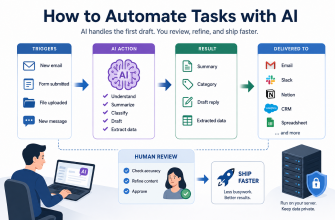
Rather than replacing humans entirely, AI is more likely to become a powerful assistant that helps people work faster, make better decisions, and automate repetitive tasks.
Conclusion
Artificial Intelligence is a technology that enables computers to perform tasks that traditionally require human intelligence. From chatbots and recommendation systems to advanced language models, AI is already part of everyday life.
Understanding the basics of AI is the first step toward exploring how these technologies can improve productivity, support innovation, and create new opportunities in both personal and professional environments.